What Is Vimshottari Dasha, and What Does Each Mahadasha Bring?
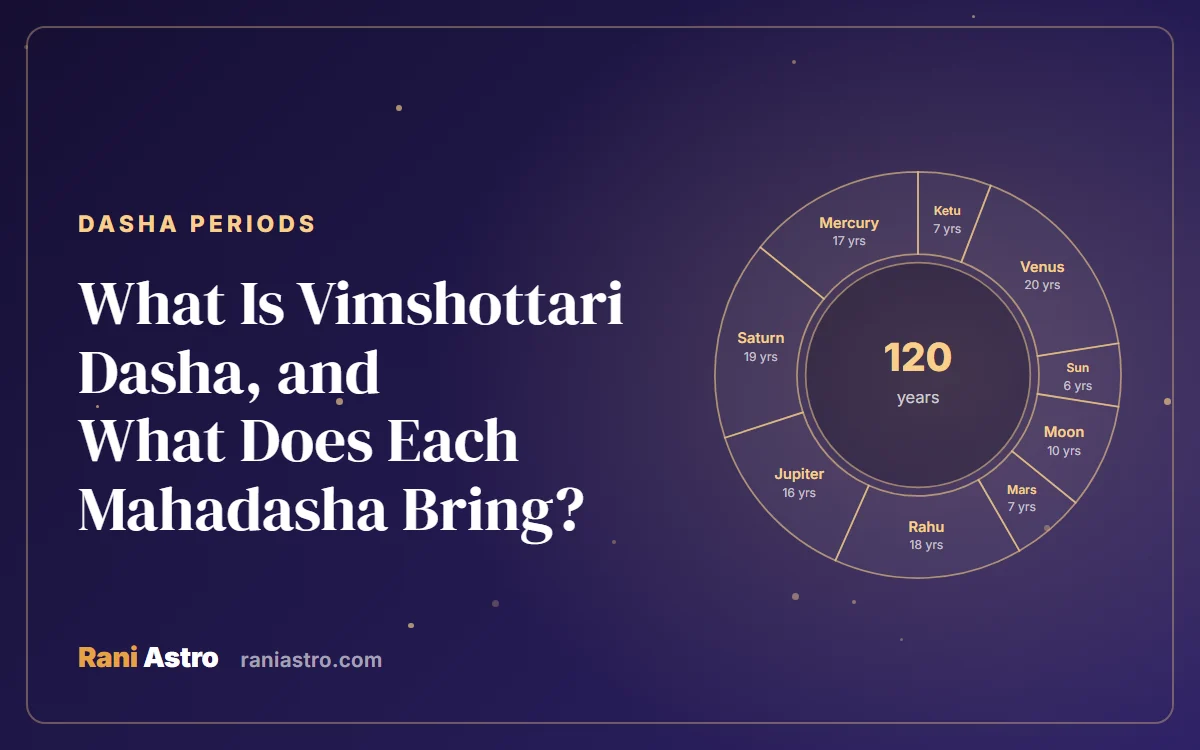
Vimshottari dasha is the 120-year cycle of planetary periods that Indian astrologers use to time events in a horoscope. Nine planets rule in a fixed order, from the Sun's 6 years to Venus's 20. The nakshatra the Moon was in at your birth decides which period you were born into, and how many years of it were left.
That leftover figure is printed in every Tamil jathagam as the dasa iruppu, the balance of dasha at birth. North Indian kundlis call the periods mahadasha and antardasha. Tamil and Malayalam horoscopes say dasa (or thisai) and bhukti. Same system, different words.
Free tool: Dasha Calculator. Your running mahadasha and antardasha, with the full 120-year table.
What Vimshottari Dasha Means
Vimshottari is Sanskrit for "twenty over a hundred", which is 120. The system is laid out in Brihat Parashara Hora Shastra, the classical text credited to the sage Parashara. That book describes several dasha systems. Vimshottari is the one most astrologers in India treat as the main clock, and it is the one your horoscope software prints by default.
Others exist. Yogini dasha runs on a 36-year cycle, Ashtottari on 108 years, and Jaimini astrologers use Chara dasha, which moves by signs. In our experience these get used as a second opinion. Vimshottari comes first.
A mahadasha is one planet's full period. Inside it run nine bhuktis (antardashas), and inside each bhukti run smaller periods again. A simple way to hold it in your head: the mahadasha planet is the season, and the bhukti planet is the weather inside that season.
The Vimshottari Dasha Table
Each of the nine planets rules three of the 27 nakshatras. The lord of your birth star is your first dasha.
| Planet | Tamil name | Years | Birth stars it rules | Same stars in Tamil |
|---|---|---|---|---|
| Ketu | Ketu | 7 | Ashwini, Magha, Moola | Aswini, Magam, Moolam |
| Venus | Sukran | 20 | Bharani, Purva Phalguni, Purva Ashadha | Bharani, Pooram, Pooradam |
| Sun | Suriyan | 6 | Krittika, Uttara Phalguni, Uttara Ashadha | Karthigai, Uthiram, Uthiradam |
| Moon | Chandran | 10 | Rohini, Hasta, Shravana | Rohini, Hastham, Thiruvonam |
| Mars | Sevvai | 7 | Mrigashira, Chitra, Dhanishta | Mirugasirisham, Chithirai, Avittam |
| Rahu | Rahu | 18 | Ardra, Swati, Shatabhisha | Thiruvathirai, Swathi, Sathayam |
| Jupiter | Guru | 16 | Punarvasu, Vishakha, Purva Bhadrapada | Punarpoosam, Visakam, Poorattathi |
| Saturn | Sani | 19 | Pushya, Anuradha, Uttara Bhadrapada | Poosam, Anusham, Uthirattathi |
| Mercury | Budhan | 17 | Ashlesha, Jyeshtha, Revati | Ayilyam, Kettai, Revathi |
Add the years and you get exactly 120. The order never changes. After Mercury comes Ketu again, and the wheel turns once more. Our page on the mahadasha sequence shows what follows each period.
Nobody lives through the whole wheel. A person born at the very start of a Ketu dasha reaches Jupiter's period only at 68 (7 + 20 + 6 + 10 + 7 + 18). Most people see five or six mahadashas in a lifetime. The first and the last of those they see only in part.
How Your First Dasha Is Worked Out
Every Vimshottari dasha calculator follows the same five steps, whether it is a phone app or an old jothidar with his ephemeris book.
- Find the Moon's exact position at birth in the sidereal zodiac. Most Indian software uses the Lahiri (Chitrapaksha) ayanamsa for this.
- Find the nakshatra. The 27 nakshatras split the 360 degrees of the zodiac into equal parts of 13 degrees 20 minutes each.
- Take the lord of that nakshatra from the table. That planet's mahadasha was running when you were born.
- Measure how much of the nakshatra the Moon still had to cross. The same share of that planet's years is your balance at birth.
- Add the next dashas in the fixed order, one after another.
An example helps. Say a child is born with the Moon at 20 degrees in Dhanu rasi (Sagittarius). Purva Ashadha (Pooradam) runs from 13 degrees 20 minutes to 26 degrees 40 minutes of Dhanu, so 20 degrees is exactly halfway through it. Purva Ashadha belongs to Venus. Half of Venus's 20 years is still to run, so the child starts life with 10 years of Venus dasha.
After that the dates fall into place.
| Mahadasha | Child's age |
|---|---|
| Venus (balance) | birth to 10 |
| Sun | 10 to 16 |
| Moon | 16 to 26 |
| Mars | 26 to 33 |
| Rahu | 33 to 51 |
| Jupiter | 51 to 67 |
| Saturn | 67 to 86 |
Why Two Printouts Show Different Dasha Dates
The Moon moves fast. It covers roughly 13 degrees a day, so about half a degree every hour, and half a degree is a little under 4% of one nakshatra. For someone born in Venus dasha, that 4% comes to close to nine months. So a birth time that is one hour wrong can shift every dasha date in the horoscope by about that much.
Near the edge of a nakshatra it gets worse. A few minutes either side can change the birth star itself. Then the whole sequence starts from a different planet.
The ayanamsa setting counts too. Lahiri is the value adopted by the Government of India's Calendar Reform Committee in the 1950s, and it is the default in most Indian software. KP astrologers use the Krishnamurti ayanamsa, which sits very close to Lahiri. Some older books follow B. V. Raman's ayanamsa, which is more than a degree away from Lahiri and can move dasha dates by many months.
One smaller cause. Some programs count a dasha year as 360 days, others as 365.25 days. If two printouts disagree by a few weeks, that is usually the reason.
Bhukti, the Period Inside the Period
A bhukti (antardasha) is a smaller period inside a mahadasha. Every mahadasha has nine of them. The first bhukti always belongs to the mahadasha planet itself, and the rest follow in the same fixed order as the table above.
The length is plain arithmetic. Multiply the mahadasha years by the bhukti planet's years, then divide by 120. Saturn's 19-year mahadasha, split this way, looks like this:
| Bhukti inside Saturn mahadasha | Length |
|---|---|
| Saturn | 3 years 0 months 3 days |
| Mercury | 2 years 8 months 9 days |
| Ketu | 1 year 1 month 9 days |
| Venus | 3 years 2 months |
| Sun | 11 months 12 days |
| Moon | 1 year 7 months |
| Mars | 1 year 1 month 9 days |
| Rahu | 2 years 10 months 6 days |
| Jupiter | 2 years 6 months 12 days |
The nine add up to 19 years. Run the same formula once more and you get the third level, called pratyantar dasha in Hindi and antharam in Tamil. The levels below that last days or hours. They only work when the birth time is known to the minute.
Our dasa bhukti guide shows how Tamil astrologers read the two levels together. The Saturn mahadasha guide goes through each of those nine bhuktis one by one.
What Each Mahadasha Usually Brings
No mahadasha is good or bad by itself. What a planet gives in its period depends on where it sits in your chart. Astrologers check the house it occupies and the houses it rules from your lagna. Then they look at its sign, and at the planets that join it or aspect it.
The notes below are only the starting themes astrologers carry in their heads before they open your chart.
Ketu Mahadasha, 7 Years
Ketu is linked with letting go. People often lose interest in things they chased for years, turn towards temples or meditation, or change course without much warning. The Ketu mahadasha guide covers it, and the Ketu-Ketu bhukti gets its own page because it is the opening stretch of just under five months.
Venus Mahadasha, 20 Years
The longest period of the nine. Astrologers look to Venus for marriage and comforts. Vehicles and jewellery come under Venus as well, along with music and the arts. A well-placed Venus in a man's chart is read for a good married life. More in the Venus mahadasha guide.
Sun Mahadasha, 6 Years
The shortest. The Sun stands for the father and for authority. Your name in society is read from it, and so are government jobs and promotions. See the Sun mahadasha guide.
Moon Mahadasha, 10 Years
The Moon is the mind and the mother. A strong Moon period is read as a settled time with plenty of travel and people around. A weak Moon can show up as worry and mood swings. Read the Moon mahadasha page.
Mars Mahadasha, 7 Years
Mars rules land and buildings, and your brothers. Police and army work come under Mars, as do surgery and sport. Mars gives energy and a short temper in equal measure. More in the Mars mahadasha guide.
Rahu Mahadasha, 18 Years
Rahu is the period people fear most, and often without reason. Astrologers link it with foreign travel and big ambition. New technology comes under Rahu too, and so does a rise from an unusual direction. The Rahu mahadasha guide explains it, and the Rahu-Rahu bhukti, which lasts 2 years 8 months 12 days, has its own page.
Jupiter Mahadasha, 16 Years
Guru is read for children and for teachers. Wealth comes under Jupiter, and so do higher study and religious life. In a traditional reading of a woman's chart, Jupiter is also looked at for the husband. See the Jupiter mahadasha guide, the Hindi-friendly Guru mahadasha phal, and the Jupiter-Jupiter bhukti.
Saturn Mahadasha, 19 Years
Sani is work and discipline. It is also delay, and the patience that delay teaches. A Saturn period usually rewards slow hard work and punishes shortcuts. Many people do their most solid work in it. Families in the North often search for Shani mahadasha phal in Hindi terms, and we have that page too.
Mercury Mahadasha, 17 Years
Budhan rules study and trade. Accounts come under Mercury too, as do writing and speech. Students and traders watch this period closely. So do people in IT jobs. Read the Mercury mahadasha guide.
Mistakes People Make When Reading Their Dasha
Most of the panic we see over a dasha comes from one of these five mistakes.
- Reading the planet's name and nothing else. A Rahu in the 10th or 11th house is read quite differently from a Rahu in the 8th.
- Mixing up Sani dasha and Ezharai Sani. Ezharai Sani (Sade Sati) is the seven and a half years when Saturn transits the 12th, 1st and 2nd signs from your Moon. It is a transit. Sani mahadasha is a dasha. You can have one without the other.
- Ignoring the bhukti. A hard mahadasha can hold a very good bhukti, and the other way round.
- Ignoring transits (gochara). Most astrologers read the dasha first and then check where Saturn and Jupiter are moving at that time.
- Trusting a printout with a doubtful birth time. If the hospital record and the family's memory disagree by an hour, the dasha dates are not reliable.
Many astrologers also watch the dasha sandhi, the few months where one mahadasha ends and the next begins. Families tend to avoid starting big things in that stretch, and some ask for a special puja.
What Families Do in a Hard Dasha
Traditional remedies follow the dasha lord. People pray to that planet's deity on its weekday, visit its Navagraha temple, chant its mantra and give in charity the grain or cloth linked with it. For Saturn that means Saturday prayers and a lamp lit with gingelly (sesame) oil. For Rahu, many families in Tamil Nadu pray to Durga during Rahu kalam.
These are acts of faith and discipline. They do not cancel a dasha, and no honest astrologer will promise a result. Each mahadasha guide linked above lists the usual remedies for that planet.
How to Check Your Own Dasha
You need three things: date of birth, time of birth as exact as you can get it, and the place. If your old jathagam is with you, look for the dasa iruppu line near the chart. It gives the dasha running at birth and how much of it was left.
If you want the full timeline worked out and read, our Lifetime Horoscope Report lists every dasha and bhukti in your chart with the dates. It also gives a year-by-year view of the next ten years, along with the rest of the horoscope. It costs ₹249, comes as a PDF on WhatsApp, and is available in 10 Indian languages.
Common Questions
Which Mahadasha Is the Best?
None is best for everyone. A mahadasha gives good results when its planet is strong and well placed from your lagna, so Venus can be wonderful for one person and dull for another.
How Do I Know Which Dasha I Am Running Now?
Take the dasa iruppu from your jathagam and add the mahadashas in order until you reach today's date. Any horoscope made from your birth details will also print the current dasha and bhukti.
What Does Dasa Iruppu Mean in a Tamil Jathagam?
Dasa iruppu is the balance of the mahadasha running at your birth, in years, months and days. Every later dasha date in the jathagam is counted from it.
Is Vimshottari Dasha Used in KP Astrology?
Yes. KP astrology uses Vimshottari dasha and builds its sub-lord system on the same 120-year proportions, with the Krishnamurti ayanamsa in place of Lahiri.
Can Two People Born on the Same Day Have Different Dashas?
Yes. The Moon moves about half a degree an hour, so two babies born a few hours apart can have different dasha balances, and different birth stars if the Moon crossed into the next nakshatra.