Is Mangal Dosha Real, and What Do the Classic Texts Say?
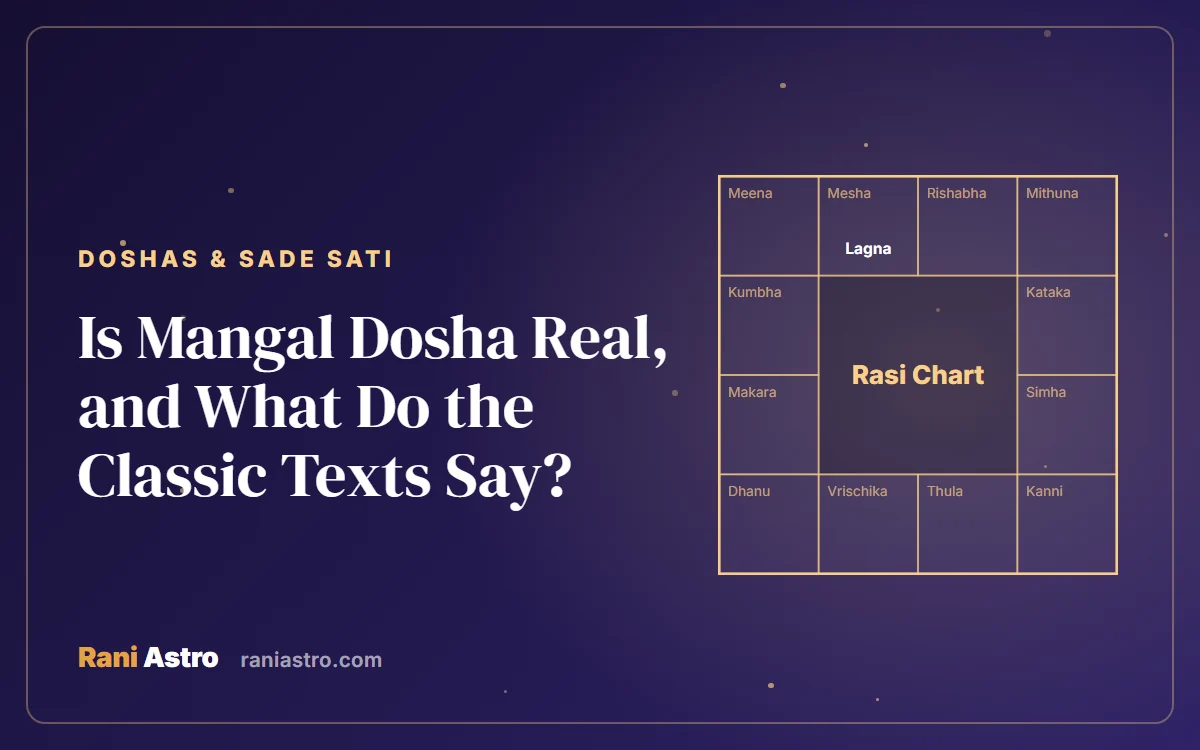
Is Mangal dosha real? Within Indian astrology, yes. It is an old rule, built on a well-known Sanskrit verse that names the houses where Mars troubles a marriage. But the same tradition gives many cancellations, and simple counting shows about half of all charts have Mars in a dosha house from the lagna. So it is real as a rule, and much narrower than the fear around it.
Whether Mars truly shapes a marriage is a different question. Science has not shown that it does. We will come to that.
Free tool: Manglik Dosha Calculator. Is there Chevvai (Mangal) dosha in your chart? Free check.
Two Questions Hiding in One
When people ask "is it real", they usually mean one of two things.
The first is whether Mangal dosha is a genuine part of Jyotisha, or something made up by modern astrologers to sell pujas. That has a clear answer. It is genuine and old.
The second is whether it works, whether Mars in the 7th house of a girl's chart really changes what happens in her marriage. That has no proof either way that would satisfy a scientist. What we can do is be honest about both.
What the Old Verse Says
Most books on matching quote a short Sanskrit verse for kuja dosha. It begins "Lagne vyaye cha patale, jamitre chashtame kuje". In plain words, it says Mars in the lagna or the 12th, or in the 4th, 7th or 8th house, harms the marriage partner.
That is five houses: 1, 12, 4, 7 and 8. North Indian astrologers mostly follow this list. South Indian practice, Tamil in particular, adds the 2nd house, which is why Chevvai dosham is counted over six houses.
Astrologers argue about which text the verse first came from. It is widely quoted in matching books and almanacs across India. The rule as families use it today is built on it.
The verse uses harsh words about the spouse. Many of the fears families carry come straight from that line, read without the rest of the tradition.
What the Same Tradition Says Next
The rest of the tradition matters as much as the verse. Classical astrology gives the cancellations alongside the rule. Here are the ones most astrologers use.
- If both partners have the dosha, it is treated as cancelled. A verse quoted in many books says exactly this, that the dosha does not harm a couple when both carry it.
- Mars in its own sign (Mesha and Vrischika are its two) or exalted in Makara does not give the dosha.
- Jupiter sitting with Mars or aspecting it softens the dosha, and for many astrologers removes it.
- For Kataka and Simha lagna, Mars is a yogakaraka (the most helpful planet for the chart), and many astrologers do not count the dosha.
So a reading that stops at "Mars is in the 7th" leaves out half of what the classical method asks for. Our Mangal dosha guide goes through each cancellation and how to check it.
The Maths Nobody Mentions
Here is a simple piece of arithmetic. Mars can be in any of 12 houses. Six of them form the dosha in the South Indian count. So, from the lagna alone, roughly half of all charts show Mangal dosha.
Now add the Moon and Venus, which many astrologers also check. With three starting points, the share of charts showing the dosha from at least one of them is well over half.
Put plainly, Mangal dosha is not a rare flaw in an unlucky few. It is one of the most common things a chart can show. That alone should calm a family that has just seen "Manglik: Yes" on a printout. Then come the cancellations, which take a good share of those charts back out.
What Science Says
There is no scientific study showing that Mars's house in a birth chart predicts how a marriage turns out. Controlled tests of astrology in general have not supported its predictions. Astrology is a matter of tradition and faith, and we say so plainly.
Many families hold both views at once. They know the science and still check the jathagam, because the elders want it, or because it gives a shared way to talk about a big decision. That is a personal and family choice. We respect it either way.
What we would push back on is fear. A good proposal turned down only because of an uncancelled "Yes" on a software printout is a loss that the classical rules themselves would not ask for.
Where Mangal Dosha Fits Among Other Doshas
Not every dosha has the same standing. Mangal dosha has a long history in matching. So does Nadi dosha, part of the old ashtakoot system. But Kaal sarp dosh does not appear in the main classical texts at all, and many South Indian astrologers do not use it.
| Dosha | Found in the classical tradition? | Common view today |
|---|---|---|
| Mangal dosha | Yes, through the kuja dosha verse and its cancellations | Widely checked in matching, with cancellations |
| Nadi dosha | Yes, part of ashtakoot matching | Widely checked in North India |
| Kaal sarp dosh | No, a later idea | Used by some, rejected by many |
How Families Can Use It Sensibly
If your family wants the jathagam checked, a few steps keep the decision in proportion.
- Get an accurate birth time. The lagna moves about every two hours, and Mars can change houses with it.
- Ask whether five houses were counted or six, and from where.
- Ask which cancellations were checked. If the answer is "none", the result is incomplete.
- Compare both charts. A dosha in both is the oldest cancellation of all.
- Look at the whole chart, not one planet. The 7th house and its lord say more about a marriage than Mars alone.
Having a Chart Read in Full
If you do want to see what your chart says, read it in full. Our Lifetime Horoscope Report checks Mangal dosha from all three starting points, applies the cancellations, and covers marriage and your dasha periods, with remedies. It costs ₹249 and comes as a PDF on WhatsApp in your language.
Our guide to doshas in kundli lists every major dosha with how it forms and how it cancels.
Common Questions
Is Mangal Dosha a Myth?
It is a real, old rule within Indian astrology, not a modern invention. Whether it predicts anything has not been shown scientifically, and the tradition itself cancels it in many charts.
Which Text Mentions Mangal Dosha?
Matching books widely quote a Sanskrit verse beginning "Lagne vyaye cha patale" that names five houses for Mars. Astrologers disagree on which original text it comes from.
Why Do So Many People Have Mangal Dosha?
Because six of the twelve houses count, about half of all charts show it from the lagna alone. Counting from the Moon and Venus as well raises the share further.
Should We Reject a Proposal Because of Mangal Dosha?
Not on a printout alone. Check the cancellations and the dosha level in both charts, and look at the whole chart before deciding.