Bhava Chalit Chart, What It Shows and How to Read It
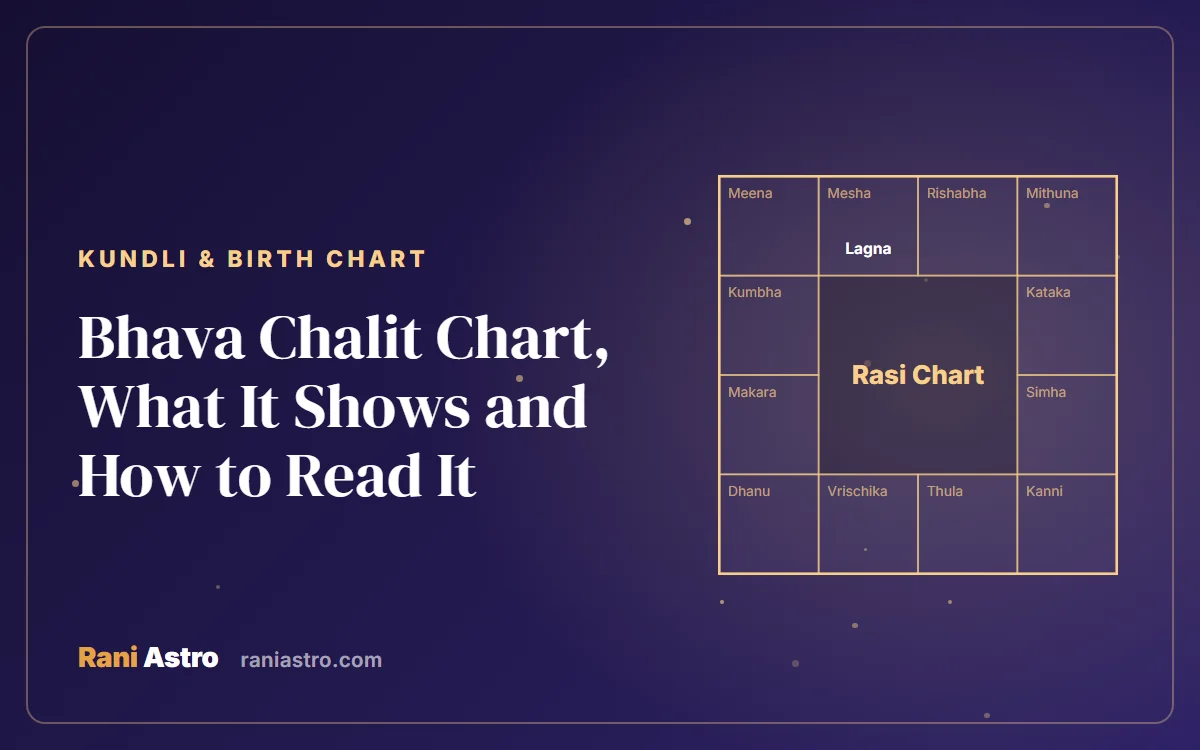
A bhava chalit chart is a version of your birth chart in which the houses are measured from the exact degree of the lagna, not from whole signs. The rising degree becomes the middle of the 1st house, and each house stretches about 15 degrees either side of its centre.
A planet sitting near the edge of a sign can therefore show in one house in the rasi chart and in the next or previous house in the chalit.
Free tool: Bhava Chalit Chart Calculator. Sripati bhavas from your lagna and midheaven: which planets shift house.
That is the whole reason people search for it. They open a computer kundli, see Venus in the 7th house in one chart and in the 6th in the other, and wonder which one is right.
Why the Two Charts Can Disagree
The ordinary rasi chart (the D1, or janma kundali) uses whole signs. Whatever sign is rising is the 1st house from its 0 degree to its 30 degree, the next sign is the 2nd house, and so on. Simple and clean.
But the lagna is not at the start of a sign. It is at a particular degree, say 25 degrees of Mesha. In the whole-sign chart, a planet at 2 degrees of Mesha and one at 29 degrees both sit in the 1st house, even though one is 23 degrees behind the rising point.
The bhava chalit fixes that. It takes the rising degree as the bhava madhya, the centre of the 1st house. The junction between two houses is called the bhava sandhi. Planets are then placed by their distance from these points, and not by the sign they happen to be in.
A Worked Example
Here is a simple case, using equal houses of 30 degrees with the lagna at 25 degrees of Mesha (Aries). The 1st bhava then runs from 10 degrees Mesha to 10 degrees Vrishabha.
| Planet and degree | House in rasi chart | House in bhava chalit |
|---|---|---|
| Venus at 5 degrees Mesha | 1st | 12th |
| Moon at 20 degrees Mesha | 1st | 1st |
| Mercury at 8 degrees Vrishabha | 2nd | 1st |
| Saturn at 15 degrees Tula | 7th | 7th |
| Mars at 3 degrees Kataka | 4th | 3rd |
Venus is in the lagna sign, but it is 20 degrees behind the rising point, so in the chalit it falls back into the 12th house. Mercury does the opposite: it is in the 2nd sign, but only 13 degrees past the lagna degree, so it stays inside the 1st bhava.
Notice that the signs never change. Venus is still in Mesha. Only its house moves.
Some kundli software uses the Sripati method instead of equal houses. Sripati divides the space between the lagna and the 10th house cusp (the midheaven) into unequal parts, so houses can be wider or narrower than 30 degrees. The idea is the same. Planets near a junction can shift.
How to Check Your Own Chart
You need the degree of the lagna and of each planet. Most computer kundlis print these in a planet table.
- Note the lagna degree. Say it is 12 degrees of Simha.
- Work out the junctions. Each bhava sandhi sits 15 degrees before the lagna degree, and the same point repeats in every sign. With a lagna at 12 degrees, the junctions fall at about 27 degrees of each sign.
- Any planet past that junction point belongs to the next house in the chalit.
- Compare with the bhava chalit your software prints. If they match, you have understood it.
- Mark the planets that shifted. Only these need a second look.
If the lagna is near the middle of a sign, around 15 degrees, the two charts usually agree almost completely. If the lagna is near 0 or 29 degrees, several planets may shift. Our page on the lagna explains why the rising degree matters so much.
Which House Should You Trust
This is where astrologers disagree, and it is better you hear that plainly.
Most North Indian astrologers who use the chalit read the signs from the rasi chart (dignity, friendship, exaltation, aspects by sign) and the house results from the chalit. So in the example above, Venus is still read as sitting in Mesha, the sign of Mars. Its house results, though, go to the 12th house of expenses and foreign travel, not to the 1st.
Many South Indian astrologers read whole-sign houses from the rasi chart for almost everything. A typical computer-printed Tamil jathagam may still include a bhava chart next to the rasi and navamsa, and the astrologer glances at it for planets near a junction. A planet sitting right on a bhava sandhi is often read as weak in giving the results of either house.
KP astrology goes further. It uses Placidus house cusps, and the cusp is the start of a house, not its middle. So a KP chart and a Parashari bhava chalit can disagree too. Our KP astrology basics page explains that system.
What we suggest is simple. Ask your astrologer which chart they use for house results, and read their predictions with that in mind. Two astrologers using different methods will sometimes give different answers for a planet near a sandhi. Neither is cheating.
What It Changes in Real Life
A shift matters most for planets that rule or occupy important houses. Take a person whose 7th lord sits at 28 degrees, close to the junction. In the rasi chart it is in the 7th; in the chalit it slips into the 8th. One astrologer reads marriage matters as straightforward; another sees delays. Same planet, same sign, different house.
That is why a bhava chalit is useful even if you mainly trust the rasi chart. It flags the planets whose house results are in doubt.
Our Free Birth Chart shows your rasi and navamsa charts with planet positions, so you can see which planets sit near a sign's edge, in about a minute after a phone OTP check. Our step-by-step kundli guide covers the rest of the reading.
Common Questions
What Is the Difference Between a Rasi Chart and a Bhava Chalit Chart?
The rasi chart puts planets in houses by whole signs. The bhava chalit puts them by distance from the exact lagna degree, so planets near a sign boundary can move one house.
Which Chart Is Correct, Lagna Chart or Chalit?
Both are correct for what they measure. Many astrologers take signs and dignity from the rasi chart and house results from the chalit, while many South Indian astrologers use the rasi chart for both.
Why Did a Planet Change House in My Chalit Chart?
It is close to a house junction (bhava sandhi), measured from your lagna degree. Its sign has not changed, only its house.
Is the Bhava Chalit Used for Marriage Matching?
No. Porutham and gun milan use the Moon's nakshatra and rasi, which do not change in the chalit.