What Is the D10 Chart, and What Does It Say About Career?
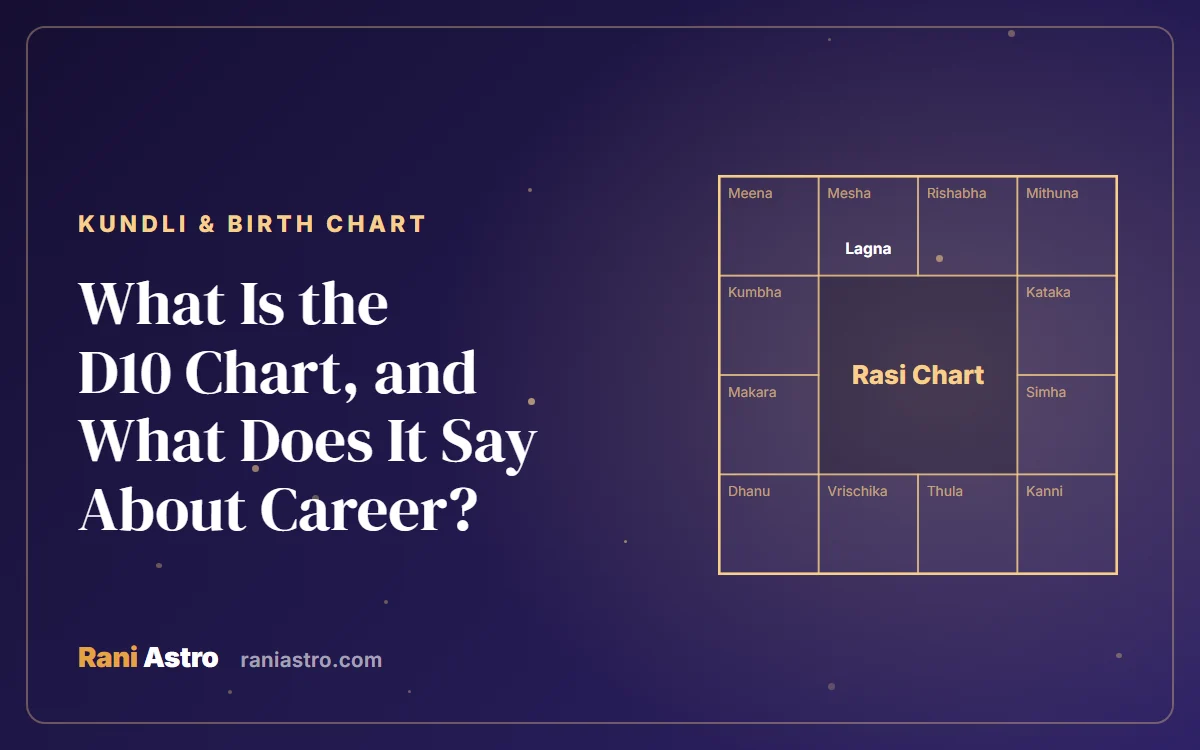
The D10 chart, also called dasamsa, is the divisional chart astrologers use for career. It divides each of the 12 signs into ten equal parts of 3 degrees, so every planet gets a new sign based on its exact degree. The lagna of the D10, its 10th house and the planets in it show the kind of work a person does and how far they rise.
It is read beside the main rasi chart (D1), never instead of it. The D1 says whether a good career is promised. The D10 shows its shape.
Free tool: D10 Chart Calculator. Your dasamsa, the career chart, with its 10th house and your 10th lord.
What Dasamsa Means
Dasamsa is Sanskrit for "one tenth part". The Brihat Parashara Hora Shastra, the main classical text of Vedic astrology, lists sixteen divisional charts (shodasa varga). The dasamsa is the one it ties to a person's actions and standing in society. In Tamil jathagam language the divisional charts are called amsam, so you may hear an astrologer say "dasamsa kattam" for the D10 box chart.
Most printed jathagams carry only the rasi and navamsa charts. The D10 usually comes from software.
How the D10 Position of a Planet Is Worked Out
The rule is short. Each sign of 30 degrees is cut into ten slices of 3 degrees.
- Note the sign and the degree of the planet in your main chart.
- Find which slice it falls in. 0 to 3 degrees is the 1st slice, 3 to 6 is the 2nd, and so on up to 27 to 30, the 10th.
- If the sign is odd (Mesha, Mithuna, Simha, Thula, Dhanu, Kumbha), start counting from that same sign.
- If the sign is even (Vrishabha, Kataka, Kanya, Vrischika, Makara, Meena), start counting from the 9th sign from it.
- Count forward by the slice number. The sign you land on is the planet's D10 sign.
Two examples make it clear.
| Planet in D1 | Slice | Count starts from | D10 sign |
|---|---|---|---|
| Mars at 14 degrees Mesha (odd) | 5th (12 to 15 degrees) | Mesha | Simha |
| Venus at 14 degrees Vrishabha (even) | 5th | Makara (9th from Vrishabha) | Vrishabha |
| Saturn at 2 degrees Thula (odd) | 1st | Thula | Thula |
| Sun at 28 degrees Kanya (even) | 10th | Vrishabha (9th from Kanya) | Kumbha |
Venus in that table lands in its own sign again. Saturn at 2 degrees Thula does the same, and Thula is also Saturn's sign of exaltation, so astrologers would call it strong in both charts.
Why the D10 Needs an Accurate Birth Time
The lagna moves through all 12 signs in about 24 hours. That is roughly one degree every four minutes. Since a D10 slice is only 3 degrees, the D10 lagna changes about every 12 minutes on average, faster for some rising signs and slower for others.
So if your birth time is "around 7 in the morning", the D10 lagna is a guess. The planets are safer. Jupiter and Saturn stay in one D10 sign for weeks, and only the Moon, which moves about 13 degrees a day, changes its D10 sign within a few hours.
Our advice is plain. Trust the D10 lagna and its houses only when the birth time is written down to the minute, from a hospital record or an old jathagam. If you are not sure, read our page on the lagna first, because the same problem starts there.
How to Read the D10 for Career
Astrologers follow roughly this order. It takes a few minutes once the chart is in front of you.
- Read the 10th house of the main chart and its lord first. This is the promise.
- Find where the D1 10th lord sits in the D10. A 10th lord in a kendra (1st, 4th, 7th, 10th) or trikona (5th, 9th) of the D10 is read as support for the career.
- Look at the D10 lagna and its lord. A strong D10 lagna lord is read as a person who stands on their own feet at work.
- Look at the 10th house of the D10 and any planet in it.
- Check which planets are exalted, in their own sign or debilitated in the D10.
- Match it with the dasha. A career change usually shows up when the dasha or bhukti lord is strong in the D10 and linked to the 10th house.
That last step is the one most people skip. A well-placed Saturn in the D10 does little for a 22-year-old running a Ketu dasha with no link to the 10th house. Our guide on how to read a kundli explains the dasha table.
What Each Planet in the D10 Chart Suggests
These are the traditional karakatvas (significations) astrologers apply when a planet is strong in the D10 or sits in its 10th house. They are tendencies, never a fixed job title.
| Planet | Work it is traditionally linked with |
|---|---|
| Sun | Government service, administration, politics, work linked to the father |
| Moon | Public dealing, nursing, hospitality, food, travel |
| Mars | Police, army, engineering, surgery, construction, sports |
| Mercury | Accounts, trade, writing, IT, teaching |
| Jupiter | Teaching, law, banking, advice, priesthood |
| Venus | Arts, film, fashion, hotels, vehicles, luxury goods |
| Saturn | Large organisations, labour, mining, oil, slow but long careers |
| Rahu | Foreign companies, new technology, aviation, unusual fields |
| Ketu | Research, precise technical work, coding, spiritual work |
Sun in the D10 Chart
A strong Sun in the D10 is the first thing astrologers check when a family asks about a government job. The Sun is exalted in Mesha and debilitated in Thula, and that holds in the D10 too.
Saturn in the D10 Chart
Saturn in the D10 is read as hard work that pays late. In a Makara, Kumbha or Thula D10 sign, Saturn often points to a long career in one organisation, and promotions that come in the late thirties or forties.
Jupiter in the D10 Chart
Jupiter in the D10 is linked with teachers, advisers, bankers and lawyers. Exalted in Kataka, it is one of the happiest D10 placements an astrologer can see. In Makara it is debilitated, and the astrologer then looks for a cancellation.
Mercury in the D10 Chart
Mercury favours work done with numbers and words: accounts, audit, trade, writing, software. Mercury is exalted in Kanya, which is also its own sign.
Ketu in the D10 Chart
Ketu is the odd one. In the D10 it is read for research, specialised technical work and sometimes a sudden change of field. Many astrologers we know see it in the charts of people who leave one line of work for something quite different.
Exalted Planets in the D10 Chart
Exaltation signs do not change between charts. In the D10, as anywhere, they are Sun in Mesha, Moon in Vrishabha, Mars in Makara, Mercury in Kanya, Jupiter in Kataka, Venus in Meena, Saturn in Thula. Astrologers differ on Rahu and Ketu, so we leave them out.
One exalted planet in the D10 is a good sign for the area of work it rules. If the same planet is also strong in the main chart, astrologers give it more weight. A planet exalted in the D10 but weak and badly placed in the D1 gives less than it seems to.
What the D10 Chart Cannot Tell You
It cannot pick your course in college. It will not name the company you join or the month you get the offer letter. What it does is narrow the field, for example telling an astrologer that a chart leans towards service in a large organisation more than running a shop. Use it that way, along with your marks, your interests and what your family can support.
Getting the Degrees You Need
Our free birth chart gives the rasi and navamsa charts along with each planet's position, after a quick OTP check on your phone. It does not draw the D10. With the planet degrees and the five steps above, you can place every planet in the dasamsa yourself.
The navamsa chart guide uses the same kind of method for the D9, and our free kundli page explains the rest of the chart.
Common Questions
Which House of the D10 Chart Shows Career?
The 10th house of the D10 shows career, along with the D10 lagna and its lord. Astrologers also check where the 10th lord of the main chart lands in the D10.
Is the D10 Chart More Important than the D1 for Career?
No. The main chart decides whether a career is promised, and the D10 is used to confirm and refine it. Most astrologers will not read the D10 on its own.
How Accurate Does the Birth Time Need to Be for the D10?
Close to the minute. The D10 lagna changes about every 12 minutes on average, so a time rounded to the half hour can give the wrong D10 lagna.
Does a Debilitated Planet in the D10 Mean No Career?
No. It means that planet's area of work will need more effort, and astrologers then check for neecha bhanga (cancellation of debility) and the rest of the chart.