Is Astrology Accurate? What Is Exact, What Is Not, and How to Judge a Reading
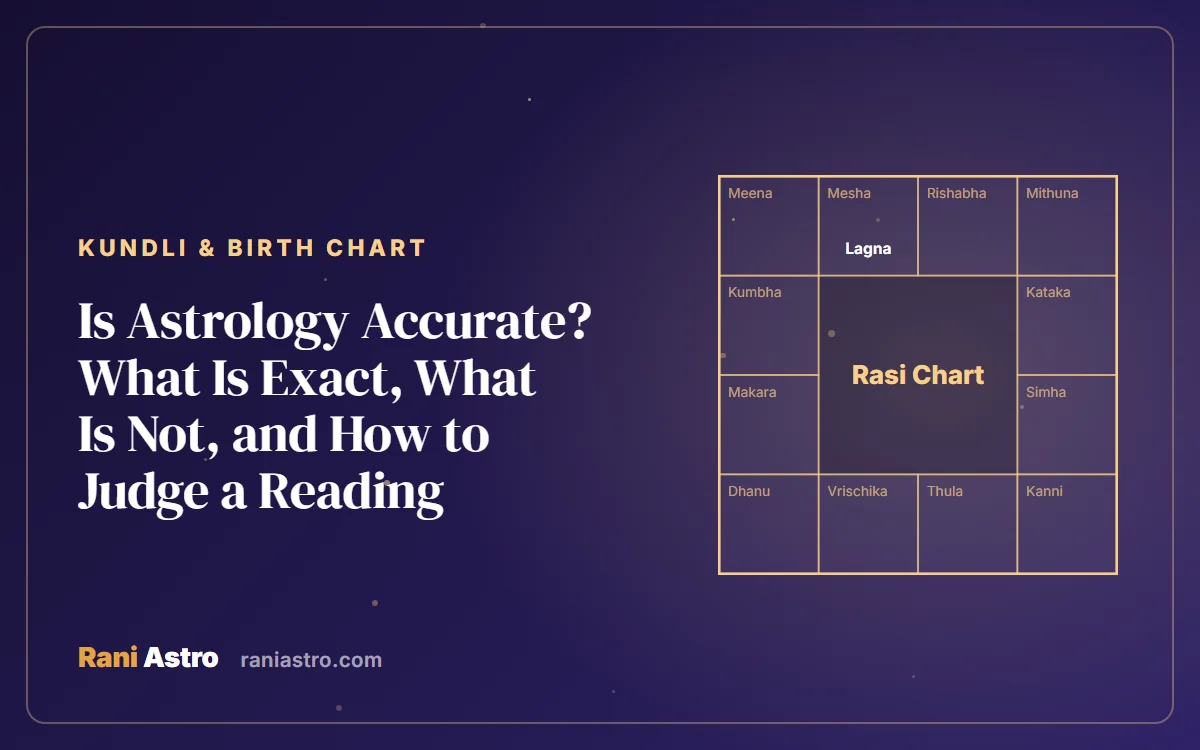
Is astrology accurate? The calculation part is. A kundli's planet positions and dasha dates come from astronomy, and good software gets them right to the minute of arc. The prediction part is a different matter. Controlled tests, including a well-known double-blind study published in the journal Nature in 1985, found astrologers did no better than chance at matching charts to people.
We run an astrology site, so you may expect us to dodge this question. We would rather answer it straight, because you can only use astrology sensibly if you know which part is which.
Free tool: Lagna Calculator. Your ascendant (lagnam) to the degree, with its lord and star.
The Part That Is Exact
Where the Moon was at 5:42 am on a given morning in Tiruchirappalli is not a matter of opinion. It is astronomy, and it can be checked against planetary tables built on NASA's own data. From there, several things follow by plain arithmetic.
- Your rasi and nakshatra, from the Moon's position
- Your lagna, from the time and place
- The Vimshottari dasha dates, from the Moon's exact degree
- The divisional charts, from each planet's degree
- Whether a classical dosha rule, such as Mars in certain houses, is present
If two charts made for the same person disagree on these, one of them has a wrong input. Usually it is the time. Sometimes it is the place or the ayanamsa setting. That is not astrology being inaccurate. It is a data entry problem, and it can be fixed.
The Part That Is Interpretation
Everything after the calculation is reading. "Guru in the 7th house brings a good spouse." "Sani dasha is hard for this lagna." These rules come from classical texts and long practice, and astrologers apply them with their own judgement. Two good astrologers can read the same chart and stress different things.
This is where the scientific tests come in.
What Scientific Tests Have Found
| Test | What was done | What was found |
|---|---|---|
| Shawn Carlson, Nature, 1985 | A double-blind test in which astrologers tried to match birth charts to personality profiles from a standard psychological questionnaire | No better than chance |
| Time twins studies | People born within minutes of each other were compared to see if they turned out alike | No effect found |
| Michel Gauquelin's "Mars effect" | Claimed Mars was placed more often in certain positions for eminent athletes | Later study by French scientists found no statistical evidence, and pointed to selection bias |
These come from the Wikipedia article on astrology and science, which lists them in more detail. Most of these tests were on Western astrology, but they test the same basic claim that birth charts describe people, and no controlled test we know of has shown Vedic astrology doing better.
There is also a well-known effect called the Forer effect, or Barnum effect. People tend to rate vague, general statements ("you are generous but can be strict with yourself") as very accurate descriptions of themselves. A lot of what feels like an accurate reading works this way.
Where Astrology Stands in India
India treats astrology differently from most countries. According to the Wikipedia article on Hindu astrology, the University Grants Commission decided to introduce Jyotir Vigyan (Vedic astrology) as a subject in Indian universities.
A 2001 judgment of the Andhra Pradesh High Court backed that decision. Many Indian scientists protested, a petition went to the Supreme Court, and in 2004 the Supreme Court dismissed it. In February 2011 the Bombay High Court dismissed a case challenging astrology's status, citing that 2004 ruling.
So in India astrology is legal and widely used. It is also taught. The courts have not said it is proven, and the scientific community has largely said it is not.
So Why Do So Many Families Use It?
In our experience, most people do not use astrology the way a scientist tests it. A family matching porutham is following a shared custom that both sides understand. A person checking their dasha before a job change is looking for a way to think about timing. A muhurtham gives a wedding a fixed, agreed time that nobody argues about.
Those uses do not depend on astrology passing a lab test. They depend on the family finding it meaningful. We think that is fair, as long as nobody is frightened or cheated in the process.
How to Judge Any Reading You Get
- Check the inputs first. Is the birth time written down or remembered? Which ayanamsa was used? A reading on a wrong lagna is worthless, however skilled the astrologer.
- Test the past before trusting the future. Ask the astrologer what the chart says about events that already happened, such as when you changed jobs or moved city. Do not tell them first.
- Note how specific the statements are. "You will face some ups and downs" fits everyone. "A move abroad in the Rahu bhukti" can be checked.
- Write predictions down with the date. Look at them again a year later. Memory keeps the hits and forgets the misses.
- Walk away from fear. A reading that ends with "do this ₹25,000 pooja immediately or your son will suffer" is a sales pitch.
- Never let a chart decide on medical treatment or a legal matter. Those need a doctor or a lawyer.
If You Want to Look at Your Own Chart
The calculation part is free and exact, and that is a good place to start. Our Free Birth Chart shows your rasi and navamsa charts, planet positions, dasha periods, yogas and dosha status in about a minute after a phone OTP check. You can then read it yourself with our guide on how to read your kundli, or compare it with an old jathagam from your family.
If you are new to the words, horoscope reading for beginners explains them, and our page on what a free kundli shows lists every item on the chart. The lagna page explains why the birth time matters so much.
Common Questions
Is Vedic Astrology More Accurate than Western Astrology?
No controlled test has shown either one to be more accurate. Vedic charts do use a different zodiac and have more timing tools, such as the dasha, but that has not been shown to improve predictions.
Why Did the Astrologer Get My Past Right?
Some statements are general enough to fit most people, and some astrologers ask questions that reveal the answer. Test by asking about specific dated events you have not mentioned.
Is Astrology Recognised in India?
It is legal and is taught in some universities after a University Grants Commission decision. The Supreme Court dismissed a petition against that in 2004. Recognition as a subject of study is not the same as scientific proof.
Can an Online Horoscope Be Accurate?
The chart calculation online is as accurate as any astrologer's, if your birth details are correct. The automatic prediction text is general. It does not weigh your whole chart the way a person would.