Shadbala, Planet Strength in Numbers
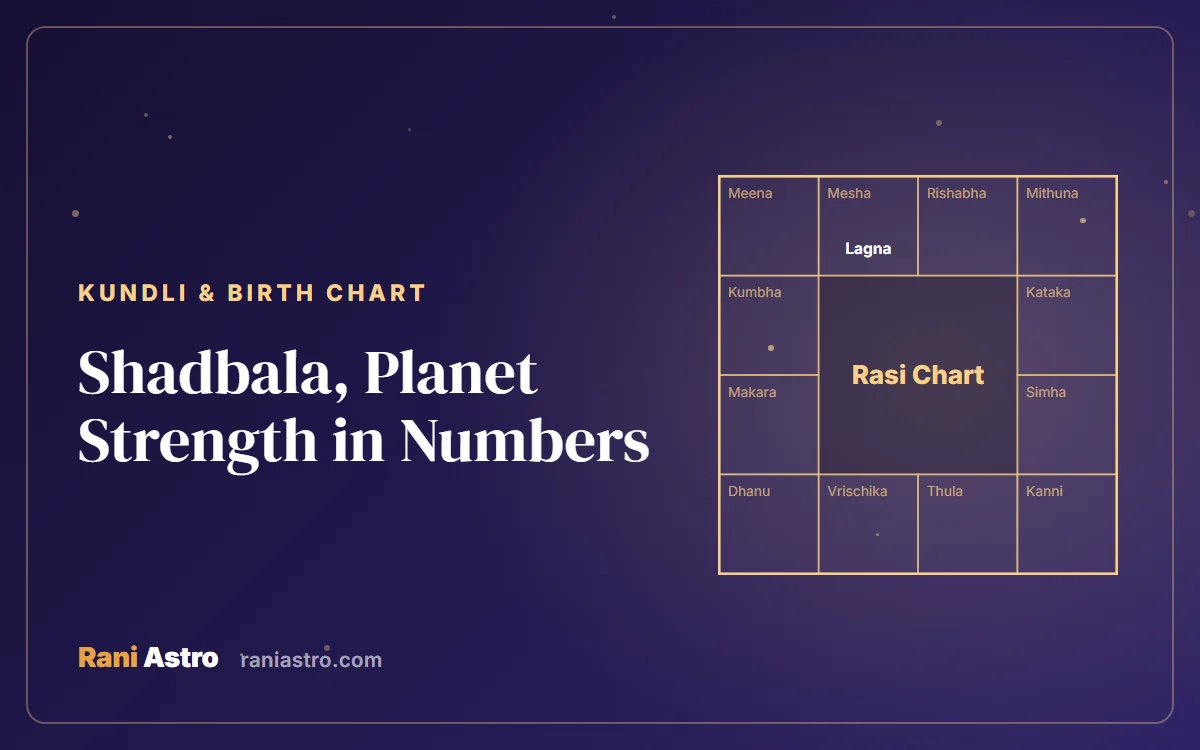
Shadbala is the six-fold strength of a planet in Vedic astrology, a single number that adds up six different measures of how strong each planet is in a birth chart. The score is given in rupas, where 1 rupa equals 60 virupas. Each planet has its own minimum. Mercury needs the most, 7 rupas. Mars and Saturn need the least, 5 each.
The rules come from the Brihat Parashara Hora Shastra, and they are worked out only for the seven visible planets. Rahu and Ketu get no shadbala in the classical method.
Free tool: Lagna Calculator. Your ascendant (lagnam) to the degree, with its lord and star.
The Six Parts of Shadbala
"Shad" means six and "bala" means strength. Each part asks a different question about the planet.
| Part | What it asks | A simple example |
|---|---|---|
| Sthana bala (positional) | Is the planet in a good sign and division? | Exalted or in its own sign, and well placed in the divisional charts |
| Dig bala (directional) | Is it in the house where it feels at home? | Jupiter and Mercury in the 1st, Sun and Mars in the 10th |
| Kala bala (temporal) | Was it born at its time? | Day births help the Sun; night births help the Moon |
| Chesta bala (motional) | How is it moving? | A retrograde planet scores high here |
| Naisargika bala (natural) | How strong is it by nature? | A fixed value, the Sun highest and Saturn lowest |
| Drik bala (aspectual) | Who is looking at it? | Benefic aspects add, malefic aspects take away |
Sthana bala itself has five pieces. The best known is uchcha bala, the exaltation score, which is 60 virupas when a planet is at its deepest exaltation point and zero at its deepest debilitation. Another piece, saptavargaja bala, checks the planet's dignity in seven divisional charts, the navamsa among them.
Dig Bala, the Easiest Part to Check Yourself
Dig bala is directional strength. Each planet is strongest in one of the four kendras (angle houses) counted from the lagna, and weakest in the house opposite.
- Jupiter and Mercury are strongest in the 1st house (east).
- The Sun and Mars are strongest in the 10th house (south, the top of the sky).
- Saturn is strongest in the 7th house (west).
- The Moon and Venus are strongest in the 4th house (north).
So a Saturn in the 1st house has almost no dig bala, while a Sun in the 10th has nearly full marks. You can read this off any birth chart in a few seconds.
Natural Strength Never Changes
Naisargika bala is the same in every chart. It ranks the planets by brightness, as the old texts saw it.
| Planet | Natural strength (virupas) |
|---|---|
| Sun | 60.00 |
| Moon | 51.43 |
| Venus | 42.86 |
| Jupiter | 34.29 |
| Mercury | 25.71 |
| Mars | 17.14 |
| Saturn | 8.57 |
The pattern is simple. Divide 60 by 7, then multiply by 7 for the Sun, by 6 for the Moon, and down by one each step until Saturn gets 1 share. This is why, when two planets are otherwise equal, the Sun counts as stronger than Saturn.
How to Read a Shadbala Table
Most kundli software prints shadbala as a table with one column per planet. Here is how to go through it.
- Find the total for each planet, usually in rupas. If it is in virupas, divide by 60.
- Compare it with that planet's minimum: Sun 6.5, Moon 6, Mars 5, Mercury 7, Jupiter 6.5, Venus 5.5, Saturn 5.
- Many programs also give a ratio, the total divided by the minimum. Above 1 means the planet has enough strength.
- Look at which parts made the score. A planet strong only through chesta bala, because it is retrograde, is a different story from one strong by sign.
- Note the strongest and weakest planets. Astrologers pay the most attention to the lagna lord and the lord of the running dasha.
For example, if Jupiter shows 7.8 rupas, its ratio is 7.8 divided by 6.5, which is 1.2. Jupiter is comfortably above its minimum. If Mercury shows 5.6 rupas, its ratio is 0.8, below the line even though 5.6 looks like a bigger number than Mars's 5.
Why It Is Done at All
Astrology has many ways to say a planet is "good" or "bad": sign, house, aspects, conjunctions, divisional charts. They often disagree. Shadbala was the classical attempt to put a number on the whole picture, so that an astrologer could compare planets fairly.
It is most used in two places. First, judging dashas: a strong dasha lord is expected to deliver its results more fully. That cuts both ways. Second, choosing remedies: a weak planet that rules good houses for the lagna is the one astrologers most often try to support.
Strong Is Not the Same as Good
This is the point people miss. Shadbala measures how much power a planet has, not whether that power helps you.
Take Mars for a Mithuna (Gemini) lagna. Mars rules the 6th and 11th houses there. A Mars with high shadbala gives strong 6th-house results, which can mean winning against rivals, or more disputes and debts. A strong Saturn for a Tula (Libra) lagna, where Saturn is the yogakaraka, is welcome. A strong Saturn for a Kataka (Cancer) lagna, where it rules the 7th and 8th, is read with more caution.
So shadbala answers "how much?" and the lagna answers "of what?". Astrologers need both. Our step-by-step kundli guide shows how lordship is read before strength.
What You Can Do with the Result
Knowing a planet is weak is not a reason to worry. Most charts have one or two planets below their minimum. In our experience a careful astrologer uses shadbala to decide where to focus, then looks at the house and the running dasha before suggesting anything.
The traditional supports for a weak but useful planet are prayer on its day, its mantra, charity linked to it, and sometimes its gemstone. A gemstone should be worn only after the whole chart is checked, because a stone strengthens a planet whatever houses it rules.
If you want to start with the basics, our Free Birth Chart shows your rasi and navamsa charts with planet positions and dasha periods, in about a minute after a phone OTP check. With that you can already check dig bala and exaltation yourself. Our beginner's page on horoscope reading explains what to look at next.
Common Questions
What Is a Good Shadbala Score?
A planet is counted strong when its total meets its own minimum, which runs from 5 rupas for Mars and Saturn up to 7 for Mercury. A ratio above 1 means it has enough strength.
Why Do Rahu and Ketu Have No Shadbala?
The classical method in the Brihat Parashara Hora Shastra covers only the seven visible planets. Rahu and Ketu are judged through their sign lord and the house they sit in.
What Is the Difference Between Rupa and Virupa?
They are units of the same score. One rupa is 60 virupas, also called shashtiamsas.
Does High Shadbala Mean Good Results?
It means the planet can give its results fully. Whether those results are good depends on the houses the planet rules from your lagna.