What Is Varshphal, and How Do Astrologers Read the Annual Chart?
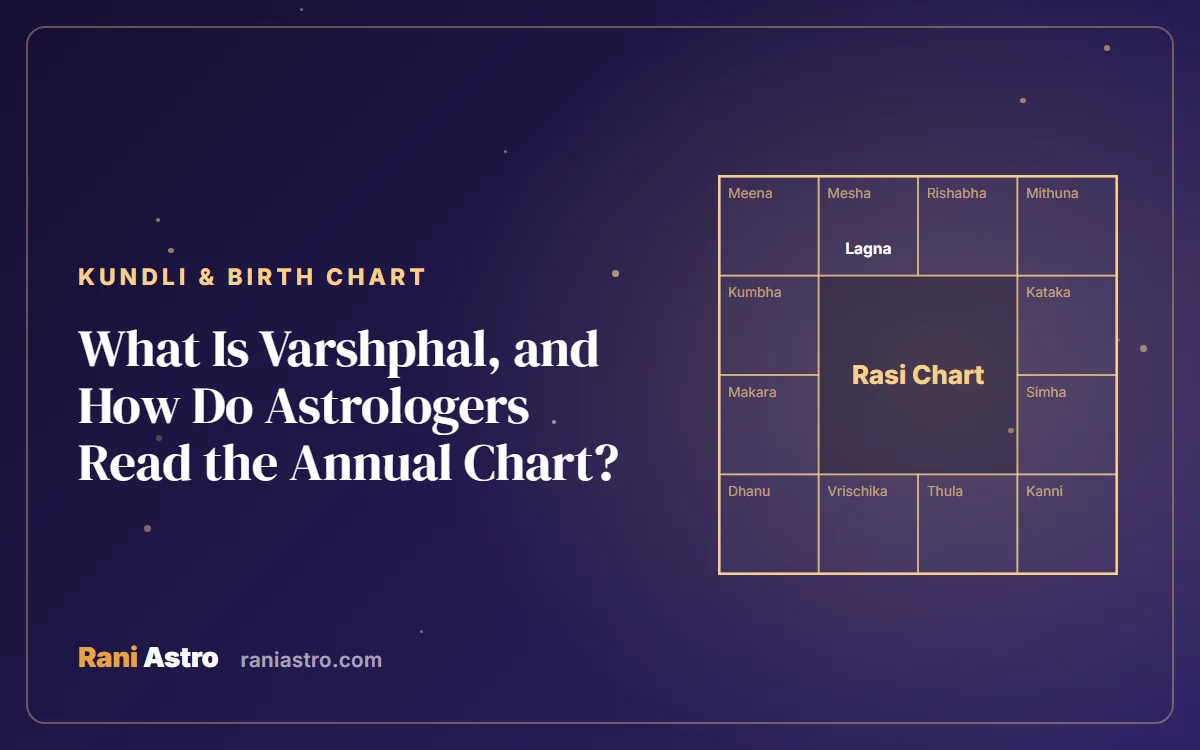
Varshphal (varshaphala, "the fruit of the year") is a chart cast for the exact moment the Sun comes back to the degree it held at your birth. It belongs to the Tajika system, which Neelakantha put into Sanskrit in his Tajika Neelakanthi in 1544. One varshphal covers one year, from one birthday to the next.
It does not start on 1 January. That surprises a lot of people who ask for a "varshphal 2027" and expect a calendar year.
Free tool: Varshaphal Calculator. Your Tajika year chart: varsha pravesh to the second, muntha and its house.
Why the Annual Chart Is Drawn at an Odd Hour
The Sun takes about 365 days and 6 hours to come back to the same point in the sidereal zodiac. So the moment of return, called varsha pravesh (entry of the year), moves roughly 6 hours later each year, and jumps back after a leap day.
Say you were born at 7:10 am. One year your varsha pravesh may fall at 1:30 pm on your birthday, the next year at 7:40 pm, then the year after on the following morning. The lagna rising at that moment becomes the varsha lagna, the ascendant of the year. Since the lagna changes sign roughly every two hours, every year's chart looks different.
One more detail matters. Indian astrologers use the sidereal zodiac, so the return is calculated with an ayanamsa (most use Lahiri). A Western "solar return" uses the tropical zodiac and gives a different moment. The two are not interchangeable.
The Parts of a Varshphal
Tajika borrowed a lot from Persian and Arabic astrology, and its vocabulary shows that. Here are the pieces you will find in any varshphal printout.
| Part | What it is | What it is read for |
|---|---|---|
| Varsha pravesh | The exact time of the solar return | Sets up the whole chart |
| Varsha lagna | The ascendant at that moment | The tone of the year |
| Muntha | A point that moves one sign a year from the birth lagna | The main area of life the year turns on |
| Varsheshwara | The lord of the year, picked from five candidates | The planet whose strength colours the year |
| Sahams | Sensitive points worked out for single questions such as marriage or children | One question each |
| Tajika yogas | Sixteen combinations with Persian and Arabic names, such as Ithasala and Ishrafa | Whether a matter comes together or falls apart |
| Mudda dasha | The Vimshottari order squeezed into one year | Which months bring what |
The Tajika aspects are also different from the Parashari ones you see in a birth chart. Tajika works with degrees and orbs, closer to Western astrology, so two planets in signs that "aspect" each other may still not form a yoga if they are too far apart in degrees.
How the Muntha Moves
The Muntha is the easiest part to work out yourself.
At birth the Muntha sits in your lagna sign. It moves forward one sign for each completed year of life. Take someone with Simha (Leo) lagna who has just finished 30 years. Thirty divided by twelve leaves 6, so the Muntha has moved six signs from Simha and sits in Kumbha (Aquarius) for that year.
Then astrologers look at which house of the varsha lagna the Muntha falls in, and at its lord. Most texts read a Muntha anywhere from the 9th to the 11th house of the annual chart as the most helpful. The 6th and 8th are read as the hardest, with the 12th close behind. A strong Muntha lord softens a weak house.
How the Lord of the Year Is Chosen
Five planets are considered for the job. They are called the panchadhikaris, the five office holders.
- The lord of the birth lagna.
- The lord of the varsha lagna.
- The lord of the sign holding the Muntha.
- The tri-rashi pati, a lord fixed by the varsha lagna sign and by whether the return happens by day or night.
- The lord of the Sun's sign for a daytime return, or of the Moon's sign for a night return.
The strongest of these that also aspects the varsha lagna becomes the varsheshwara. If Jupiter wins and is well placed, astrologers read a year of growth and good advice. If a weak Saturn wins, a year of slow work and patience.
The Mudda Dasha, a Year Cut into Nine Parts
The mudda dasha takes the 120-year Vimshottari cycle and shrinks it into one year in the same proportions. Most astrologers count the year as 360 days for this, and some use 365.
| Planet | Vimshottari years | Mudda dasha days (360-day year) |
|---|---|---|
| Ketu | 7 | 21 |
| Venus | 20 | 60 |
| Sun | 6 | 18 |
| Moon | 10 | 30 |
| Mars | 7 | 21 |
| Rahu | 18 | 54 |
| Jupiter | 16 | 48 |
| Saturn | 19 | 57 |
| Mercury | 17 | 51 |
The planet it starts from depends on your birth star and your age, so it is different every year. A 60-day Venus period inside a good year is where many astrologers look for a wedding or a big purchase.
How Astrologers Use Varshphal with the Birth Chart
The birth chart comes first. Always. The D1 rasi chart and the running Vimshottari dasha tell you what a period of life can hold. The varshphal tells you which of those things are likely to show up in this particular year.
A good annual chart cannot give what the birth chart does not promise. If the natal chart shows no strong yoga for property, a fine varshphal will not suddenly produce a house. It may produce a good year for repairs or for saving money.
For 2027, the slow planets give useful context. Jupiter goes back to Kataka on 25 January 2027 and returns to Simha on 26 June 2027. Saturn enters Mesha on 3 June 2027 and goes back to Meena on 20 October 2027. Your varshphal for a birthday in 2027 will place these moves inside your own year.
B. V. Raman, the Bengaluru astrologer who edited The Astrological Magazine for over sixty years, wrote a whole book on it, "Varshaphal or the Hindu Progressed Horoscope". It is still one of the clearer English introductions.
Lal Kitab Varshphal Is a Different Thing
If you have a Lal Kitab report, it may also have a page called varshphal. That one works differently. Lal Kitab moves the planets of the birth chart into new houses each year using a fixed table, without casting a fresh chart for the solar return. Our page on the Lal Kitab kundli explains how that system reads houses.
Both are called varshphal. Ask which one you are being given.
Mistakes That Spoil a Varshphal Reading
- Reading it for the calendar year. The Tajika year runs birthday to birthday.
- Using a wrong birth time. The return moment comes from the Sun's exact degree at birth, which depends on the birth time. A time 20 minutes off moves the return by about 20 minutes too. The varsha lagna then shifts by roughly 5 degrees, sometimes into the next sign.
- Treating it as a separate horoscope. It is a magnifying glass on one year of the natal chart.
- Mixing tropical and sidereal software. A Western solar return app and an Indian varshphal will disagree, and both will look "right" on screen.
- Panicking over one bad saham. Sahams answer narrow questions and are read last.
If you are new to all this, our guide on how to read your kundli is the place to start, and Vedic astrology for beginners explains the basic terms.
Where to Begin with Your Own Chart
You need your birth chart before any varshphal makes sense. Our Free Birth Chart gives you the rasi and navamsa charts, planet positions and your dasha periods in about a minute after a phone OTP check. Note your lagna there, then count the Muntha for your age as shown above. It is a good first exercise.
If you want to see how a full reading is laid out, our page on what a detailed horoscope report contains walks through it.
Common Questions
What Is Varshphal in Kundli?
Varshphal is the annual chart of the Tajika system, cast for the moment the Sun returns to its birth degree. It is read together with the birth kundli for one year at a time.
Does Varshphal Start on My Birthday or on 1 January?
On your birthday, at the exact time of the solar return. That time can fall a day before or after your calendar birthday.
What Is Muntha in Varshphal?
Muntha is a point that starts in your birth lagna and moves one sign per completed year of life. The house it falls in within the annual chart shows the area the year turns on.
Is a Varshphal Report for 2027 the Same for Everyone with My Rasi?
No. A varshphal depends on your own birth time and lagna, and on your age. Rasi-wise yearly predictions are general and use only the Moon sign.
Can Varshphal Be Read Without a Birth Time?
Not properly. Without a birth time there is no natal lagna, so there is no Muntha and no reliable varsha lagna.