Vedic vs Western Astrology, What Is Different and Why Your Sign Changes
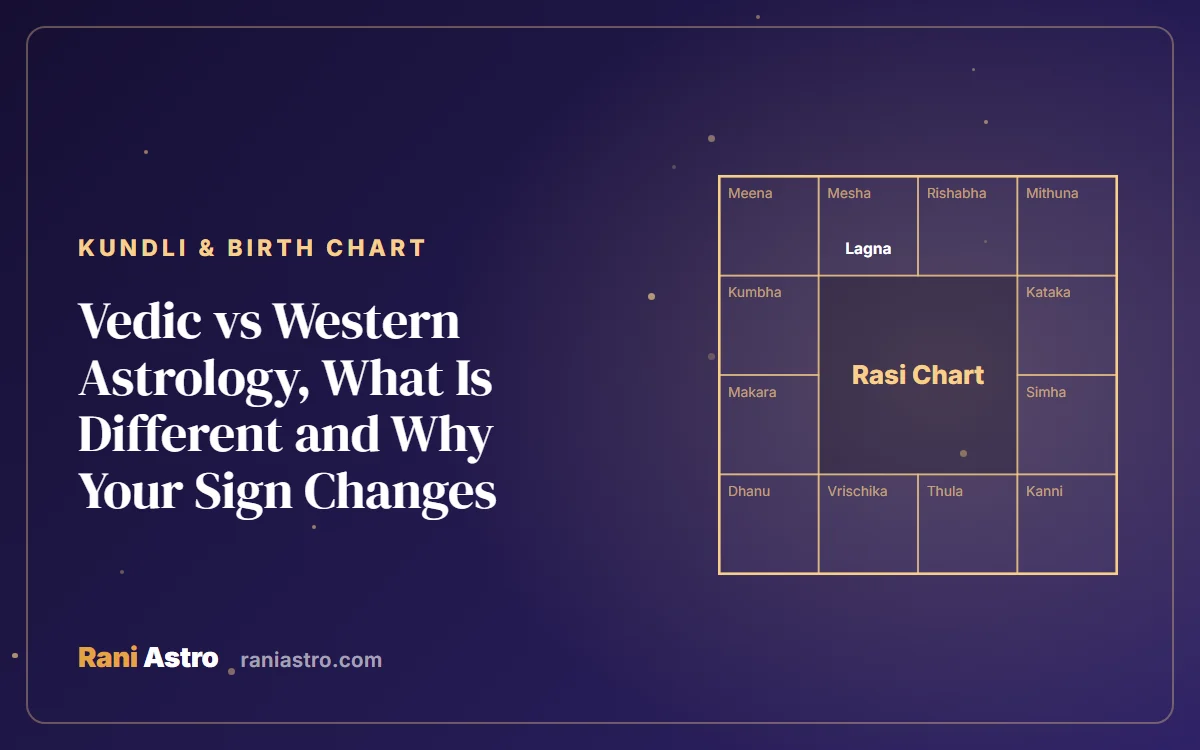
The biggest difference in Vedic vs Western astrology is the zodiac itself. Western astrology uses the tropical zodiac, fixed to the seasons, while Vedic astrology uses the sidereal zodiac, fixed to the stars. The two are now a little over 24 degrees apart, so most people's Sun sign in a Vedic chart is one sign behind their Western one.
That is why someone who has read "Aries" all their life in an English magazine finds "Meena" on their janam kundali. Neither chart has made a mistake. They are measuring from different starting points.
Free tool: Vedic vs Western Sign. Every planet in both zodiacs, with the ones that change sign marked.
Why the Two Zodiacs Drift Apart
The Earth wobbles slowly on its axis, a movement called the precession of the equinoxes. Because of it, the point where the Sun crosses the equator in March slides backward against the stars by about one degree every 72 years. A full cycle takes roughly 25,800 years.
Western astrology starts Aries at that March equinox point every year, wherever the stars are. Vedic astrology starts Mesha at a fixed point among the stars. The gap between the two is the ayanamsa. With the Lahiri ayanamsa, used by most Indian astrologers and panchangams, it is a little over 24 degrees in 2026 and growing by about a degree every 72 years.
The Main Differences Side by Side
| Point | Vedic (Jyotish) | Western |
|---|---|---|
| Zodiac | Sidereal, tied to the stars | Tropical, tied to the seasons |
| Main sign people know | Moon sign (rasi) | Sun sign |
| Star divisions | 27 nakshatras, each 13 degrees 20 minutes | Not used |
| Planets | The seven visible planets with Rahu and Ketu | The seven, with the outer planets Uranus to Pluto |
| Houses | Mostly whole sign, one sign per house | Mostly Placidus or similar unequal houses |
| Aspects | Full aspects by house count (all planets 7th; Mars, Jupiter and Saturn have extra ones) | Aspects by exact angle with orbs (conjunction, square, trine, opposition) |
| Timing tool | Dasha systems, mainly Vimshottari over 120 years | Transits, progressions, solar returns |
| Extra charts | Divisional charts such as navamsa | Rarely used |
| Marriage matching | Porutham or 36 point guna milan | Synastry, comparing two charts by aspects |
The Moon Comes First in India
Ask an Indian what their sign is and they will usually give their rasi, the Moon sign. Ask someone in London and they will give their Sun sign. This is more than habit. Vedic astrology builds much of its working method around the Moon: the birth star, the dasha sequence, daily panchangam readings, Ezharai Sani (sade sati), and marriage matching all start from the Moon.
Western astrology does use the Moon, but popular horoscope columns run entirely on Sun signs. That is one reason Western columns feel general to Indian readers. Twelve groups for the whole world is a very rough cut.
The Tamil Calendar Is a Vedic Sun Sign Calendar
Here is a neat check that the sidereal zodiac is not a strange idea. The Tamil months are solar months. Each one begins when the Sun enters a sidereal sign.
| Tamil month | Sun in (Vedic sign) | Western Sun sign for most of the month |
|---|---|---|
| Chithirai | Mesha | Aries ends, Taurus begins |
| Vaikasi | Rishabha | Taurus, then Gemini |
| Aani | Mithuna | Gemini, then Cancer |
| Aadi | Kataka | Cancer, then Leo |
| Avani | Simha | Leo, then Virgo |
| Purattasi | Kanya | Virgo, then Libra |
| Aippasi | Tula | Libra, then Scorpio |
| Karthigai | Vrischika | Scorpio, then Sagittarius |
| Margazhi | Dhanu | Sagittarius, then Capricorn |
| Thai | Makara | Capricorn, then Aquarius |
| Maasi | Kumbha | Aquarius, then Pisces |
| Panguni | Meena | Pisces, then Aries |
Tamil Puthandu, the new year, falls around 14 April, when the Sun enters sidereal Mesha. Western Aries began weeks earlier, around 21 March. Thai Pongal, in mid-January, marks the Sun entering sidereal Makara. Malayalam, Odia and Bengali solar calendars follow the same sidereal entries, under their own month names.
Dasha Against Progressions, the Timing Question
The two systems also answer "when?" in different ways. A Vedic astrologer reads time mainly through the Vimshottari dasha, a fixed 120 year sequence of planetary periods that starts from your birth star. Ketu gets 7 years, Venus 20, the Sun 6, the Moon 10, Mars 7, Rahu 18, Jupiter 16, Saturn 19 and Mercury 17.
A Western astrologer has no such sequence. They watch the planets moving today against the birth chart, and use progressions, where each day after birth stands for one year of life.
So a Vedic reading can say "your Guru dasha begins in your 34th year" from the birth chart alone. A Western reading builds its timing from the sky as it moves.
Which One Should You Follow?
Pick one and stay with it. Mixing a Western Sun sign with a Vedic dasha reading will only confuse you, because the planets will appear to be in different signs.
If your family decisions run on porutham and muhurtham, as they do in most Indian homes, you need the Vedic chart. Western astrology has its own long tradition and plenty of followers abroad, and some Indians enjoy reading both. Just know which one you are reading at any given time.
How to See Your Vedic Signs
You need your birth details, with the time as exact as your family can give it. Our Free Birth Chart gives your Vedic rasi, nakshatra, lagna, planet positions and dasha periods in about a minute after a phone OTP check. If the Sun sign surprises you, the 24 degree gap is the reason.
For reading the chart once you have it, our guide on how to read your kundli goes house by house, and horoscope reading for beginners explains the words that come up most. A free kundli online should always tell you which ayanamsa it uses. If it does not say, ask.
Common Questions
Why Is My Vedic Sun Sign Different from My Western Sun Sign?
Vedic astrology uses the sidereal zodiac, which is now a little over 24 degrees behind the tropical zodiac of Western astrology. Unless your Sun is in the last 6 degrees or so of a Western sign, it falls in the previous sign in the Vedic chart.
Is Vedic Astrology More Accurate than Western Astrology?
There is no tested evidence that either one is more accurate. They use different zodiacs and methods, and each has its followers. Indian family customs such as porutham and muhurtham need the Vedic chart.
Does Vedic Astrology Use Uranus, Neptune and Pluto?
Classical Vedic astrology does not. It uses the seven visible planets plus Rahu and Ketu, the Moon's nodes.
Is the Rising Sign Also Different in Vedic Astrology?
Yes, for the same reason. Most people's Vedic lagna is one sign behind their Western rising sign, unless the Western rising degree is late in its sign.