Ketu in Vedic Astrology, What It Rules and How It Works in a Chart
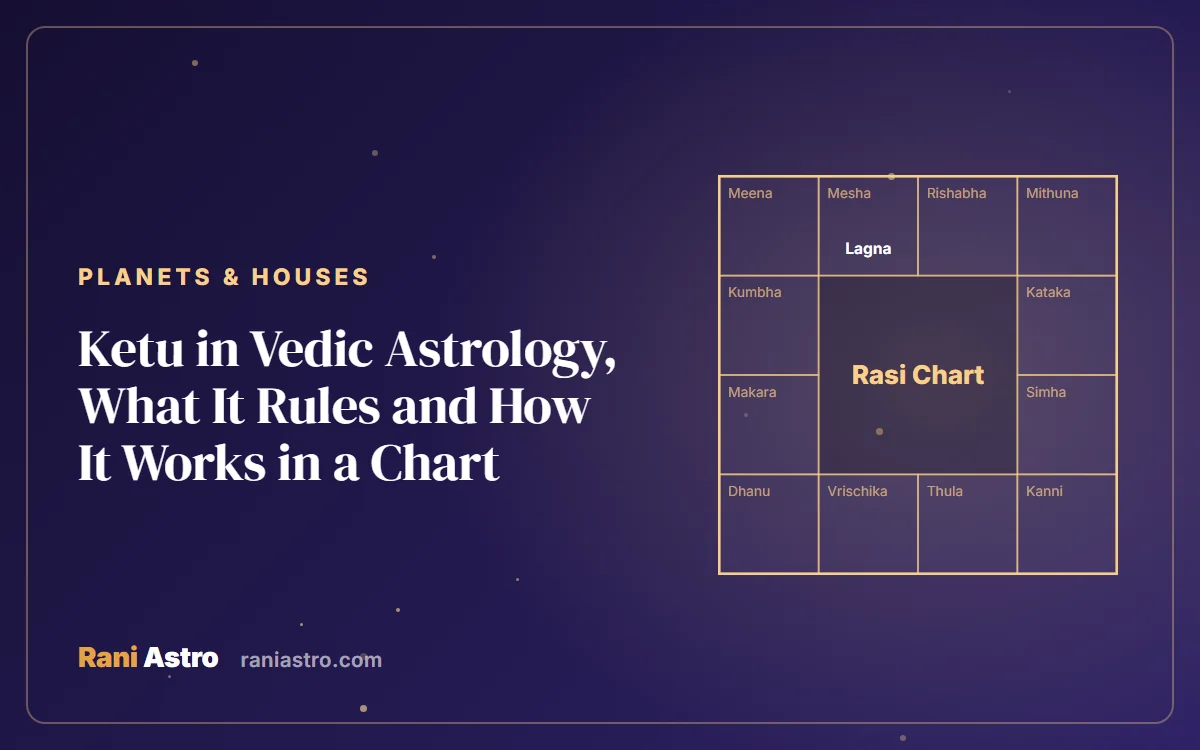
Ketu in Vedic astrology is the south node of the Moon, one of the two shadow planets (chhaya grahas) along with Rahu. It has no body and owns no sign in Parashara's scheme, but it rules three nakshatras, Ashwini, Magha and Moola, and its dasha lasts 7 years. Only the Sun's 6 year dasha is shorter. Mars ties with Ketu at 7.
Astrologers read Ketu for detachment and loss on one side and for spiritual pull on the other. Both come from the same idea. Ketu takes things away, and what is left is the person.
Free tool: North Node Calculator. Your Rahu and Ketu sign, mean and true node, in both zodiacs.
Where Ketu Comes From
The Puranas tell of the churning of the ocean (Samudra Manthan). An asura called Svarbhanu slipped in among the devas and drank the nectar. The Sun and the Moon spotted him, and Vishnu, as Mohini, cut off his head with the Sudarshana chakra. The head became Rahu and the body became Ketu. Having tasted the nectar, both lived on.
In astronomy the story maps onto two real points. The Moon's path crosses the Sun's path at two places, the nodes. Rahu is the north node, where the Moon crosses going up, and Ketu is the south node. Eclipses happen only when the Sun and Moon are near these points, which is why the story ties Rahu and Ketu to grahanam.
Ketu at a Glance
| Point | Ketu |
|---|---|
| Nature | Shadow planet, the south lunar node |
| Signs owned | None in Parashara's main scheme, some give it Vrischika |
| Exaltation | Disputed, Vrischika or Dhanu depending on the school |
| Nakshatras | Ashwini (Aswini), Magha (Magam), Moola (Moolam) |
| Dasha length | 7 years |
| Motion | Always retrograde, about 18 months in each sign |
| Position | Always exactly opposite Rahu |
| Gem | Cat's eye (vaiduryam, lehsunia) |
| Deity usually worshipped | Ganesha |
Why Ketu Is Linked with Loss and with Moksha
A headless body cannot want anything. That is the image astrologers use. Rahu, the head, hungers for the world. Ketu, the body without the head, has already had and lost. Where Ketu sits in your chart, the tradition says you will feel less attached, and sometimes less satisfied, with that part of life.
That sounds negative, and in a worldly reading it often is. Ketu in the 2nd can mean irregular savings, Ketu in the 7th a distance in marriage.
But the same quality is called moksha karaka, the significator of liberation. Classical astrologers counted Ketu's house as the place where a person lets go most easily. Many traditional astrologers saw Ketu in the 12th house, the house of moksha, as a sign of someone drawn to spiritual life.
Ketu is also linked with sharp, sudden events. Intuition is Ketu's too, and so are old subjects like mantra and the occult.
Kuja Vat Ketu, Ketu Acts Like Mars
There is an old working rule, "Kuja vat Ketu": Ketu gives results like Mars. Ketu is fiery and cutting, much as Mars is. Another rule says a node gives the results of the lord of the sign it sits in, and of the planets sitting with it.
Put the two together and you have the method most astrologers use.
- Find the sign Ketu sits in, then find that sign's lord. Ketu will lean on that planet.
- Note any planets in the same sign as Ketu. Ketu takes on their colour.
- Read the house Ketu is in, counted from the lagna.
- Read the opposite house, where Rahu sits. The two are one axis, so the 4th and 10th, or the 1st and 7th, are always read together.
For the other node, our page on Rahu in Vedic astrology uses the same method from the other end.
Ketu with Other Planets
When Ketu joins a planet in the same sign, it tends to cut that planet off from the world in some way. These are the readings you will hear most often.
| Ketu with | What astrologers often read |
|---|---|
| Sun | Questions about the father or about self-confidence |
| Moon | An inward, worried mind, a grahan yoga to some astrologers |
| Mars | Heat, sudden anger, accidents to watch for |
| Mercury | Unusual or very fine thinking, or scattered nerves |
| Jupiter | Spiritual leaning, interest in scripture |
| Venus | Detachment in love, or very fine artistic taste |
| Saturn | A hard, lonely discipline, renunciation in some charts |
The Moon case is the one families ask about most, because the Moon is the mind. A Moon with Ketu is read more gently when Jupiter aspects it.
The Ketu Dasha
The Ketu mahadasha is 7 years long. It comes after Mercury's 17 years and is followed by Venus's 20 years. That position matters. Ketu is a short gap between two longer, more worldly periods.
A child born in Aswini, Magam or Moolam nakshatra starts life in the Ketu dasha. Because Ketu's period is only 7 years, such children usually move into the long Venus dasha before they finish school.
A Ketu dasha in adult life is often described as a time of endings and inward turning. A job closes, a city is left behind, interest in pilgrimage or prayer grows. It is not a curse. Many people do well in it when Ketu is placed in the 3rd, 6th or 11th house, where malefics are read as helpful.
What Families Traditionally Do for Ketu
Ganesha is the deity most families turn to for Ketu, and Vinayaka Chaturthi has extra weight for those running Ketu dasha. In Tamil Nadu the Ketu sthalam is Keezhaperumpallam, near Poompuhar, one of the nine Navagraha temples of the Kaveri delta. A multi-coloured cloth and horse gram (kollu) are traditional offerings at Navagraha shrines.
The cat's eye is Ketu's gem. It is the stone astrologers are most cautious about, because Ketu's results are sudden. Wear it only after your chart has been checked, and many astrologers advise a trial period first.
Reading Ketu needs the whole chart, the Rahu axis and the dasha timing. Our Lifetime Horoscope Report, ₹249, covers your planets with your dasha and bhukti periods, delivered as a PDF on WhatsApp. For the bigger picture, see the guide to the 12 houses and 9 planets, and our pages on Mars and Jupiter, the two planets Ketu is most often compared with.
Common Questions
Is Ketu a Malefic Planet?
Ketu is counted among the natural malefics with Saturn, Mars, Rahu and the Sun. It is also the significator of moksha, so astrologers read it as harmful for worldly matters and helpful for spiritual ones.
Which Sign Is Ketu Exalted In?
Schools differ. Many astrologers take Vrischika as Ketu's exaltation sign, opposite Rahu in Vrishabha. Others use Dhanu, opposite Rahu in Mithuna.
What Is Ketu Called in Tamil?
Ketu, sometimes written Kethu. The Rahu-Ketu transit is called Rahu Ketu peyarchi.
How Long Does Ketu Stay in a Sign?
About 18 months. It moves in reverse through the zodiac, always opposite Rahu.