How Do Planet Aspects Work in Vedic Astrology?
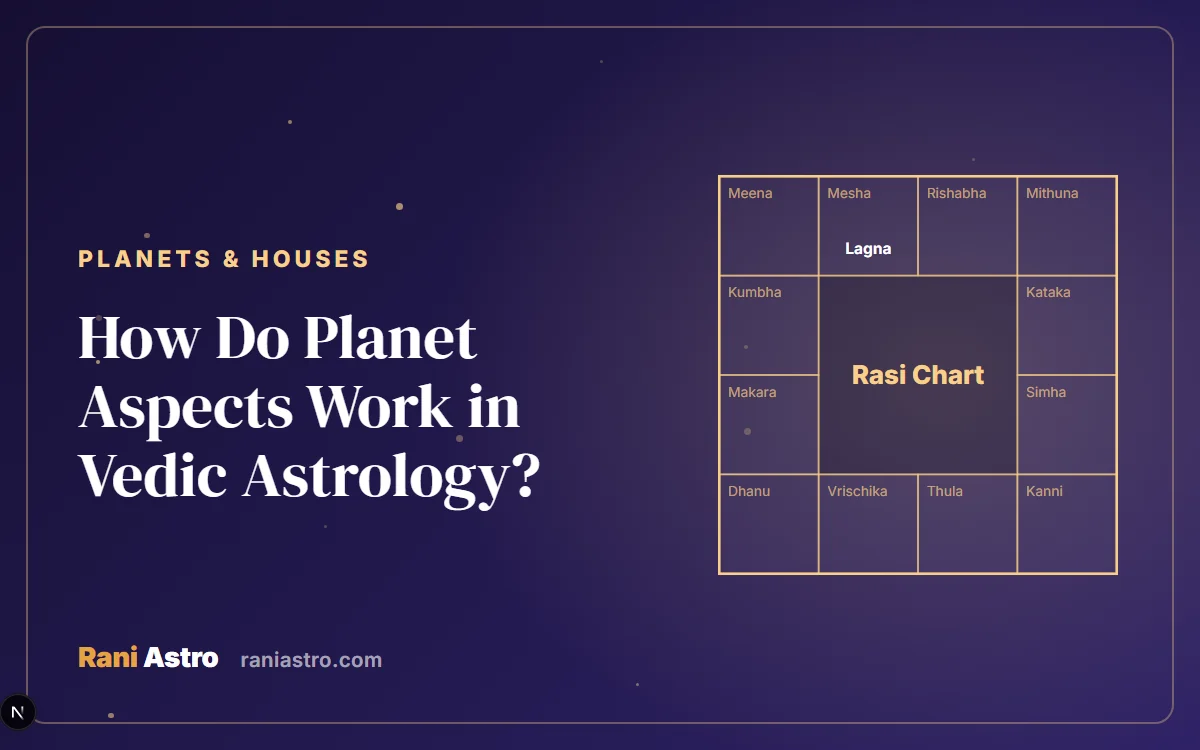
Planet aspects in Vedic astrology are called graha drishti, the "sight" of a planet. Every planet looks at the 7th house counted from where it sits. Three planets have extra sight: Mars also aspects the 4th and 8th, Jupiter the 5th and 9th, and Saturn the 3rd and 10th. A house that receives an aspect is touched by that planet even when it is empty.
That one rule explains a lot. It is why an astrologer can talk at length about your marriage house even when your chart shows nothing at all sitting in it, because Saturn or Jupiter is looking at it from somewhere else.
Free tool: Lagna Calculator. Your ascendant (lagnam) to the degree, with its lord and star.
The Aspect Table
Count the house the planet is in as 1, then count forward.
| Planet | Aspects these houses from itself |
|---|---|
| Sun (Surya) | 7th |
| Moon (Chandra) | 7th |
| Mercury (Budhan) | 7th |
| Venus (Sukran) | 7th |
| Mars (Sevvai, Mangal) | 4th, 7th, 8th |
| Jupiter (Guru) | 5th, 7th, 9th |
| Saturn (Sani) | 3rd, 7th, 10th |
| Rahu and Ketu | 5th, 7th, 9th in some traditions, others give them no aspect or only the 7th |
The last row is where schools split. Many South Indian astrologers give the nodes Jupiter's aspects. Others say a shadow planet cannot "see" at all. Ask the jothidar who reads your jathagam which view they follow, and you will understand their reading better.
Why Some Planets See Further
The classical idea is that every planet aspects all houses a little, but only the 7th fully. Brihat Parashara Hora Shastra gives the fractions:
- A quarter aspect on the 3rd and 10th houses
- A half aspect on the 5th and 9th
- A three-quarter aspect on the 4th and 8th
- A full aspect on the 7th
Then the exceptions. Saturn's quarter aspects on the 3rd and 10th become full. Jupiter's half aspects on the 5th and 9th become full. Mars's three-quarter aspects on the 4th and 8th become full.
Most astrologers today ignore the fractions. The fractions still show up in shadbala (planetary strength) calculations, which software does for you.
The old explanation for the special aspects ties them to each planet's nature. Saturn, the planet of work and delay, watches the 3rd (effort) and 10th (career). Jupiter, the guru, blesses the 5th (children, merit) and 9th (dharma, fortune), both trikona houses. Mars, the warrior, watches the 4th (home, land) and 8th (danger). It is a neat story, and it helps you remember the table.
How to Check Aspects in Your Own Chart
- Find the planet in your rasi chart and note its house number from the lagna.
- Count that house as 1. Count forward 7 houses. That house gets the planet's aspect.
- Add the special aspects for the three planets that have them, using the table above.
- Note which planets sit in the houses that are aspected. They receive the aspect too.
- Do this for every planet, then look at your important houses one by one: 1st, 7th, 10th.
In a South Indian chart the signs are fixed in their boxes, so you count the boxes clockwise from the lagna box. In a North Indian chart the houses are fixed and the signs move, so you count the diamonds anticlockwise from the top centre. The counting is the same.
Three Worked Examples
Saturn in the 7th house aspects the 9th house and the 1st. Its third aspect lands on the 4th. So a Saturn in the marriage house also presses on the self (1st), the home and mother (4th) and fortune (9th). That is why a reading of Saturn in the 7th house often talks about more than marriage.
Jupiter in the lagna (1st house) aspects the 5th house of children, the 7th of the spouse and the 9th of fortune. Three good houses at once. This is one of the most praised positions for Jupiter in any chart.
Mars in the 2nd house aspects the 5th and 9th, and also the 8th. The 2nd is already a chevvai dosham house in the Tamil list. Its aspect on the 8th, the mangalya sthana, is part of why that list counts the 2nd at all.
What an Aspect Does
An aspect works like a planet's presence, just weaker. A natural benefic (Jupiter, Venus, a strong Moon, an unafflicted Mercury) protects and helps the house it aspects. A natural malefic (Saturn, Mars, the Sun, Rahu, Ketu) puts pressure on it.
The planet's lordship for your lagna changes this. Saturn is a natural malefic, but for Rishabha and Thula lagnas it is the yogakaraka, and its aspect helps. Jupiter is a natural benefic, but for Thula lagna it rules the 3rd and 6th, so its aspect is mixed. See benefic and malefic planets for each lagna for your own list.
Two more points. When two planets sit 7 houses apart, they aspect each other, and astrologers call it a mutual aspect (samasaptaka in Sanskrit, meaning seventh to each other). Mutual aspect between friends is read as cooperation; between enemies, as tension. And Jupiter's aspect is the one astrologers value most. "Guru paarvai kodi nanmai" is a common Tamil saying for it: Jupiter's sight brings a crore of good.
Rashi Drishti, the Other System
Everything above is Parashara's graha drishti, planet to house. The Jaimini system adds rashi drishti, sign to sign. Its rule is different:
| Sign type | Signs | Aspects |
|---|---|---|
| Movable (chara) | Mesha, Kataka, Thula, Makara | All fixed signs except the one next to it |
| Fixed (sthira) | Rishabha, Simha, Vrischika, Kumbha | All movable signs except the one next to it |
| Dual (dwiswabhava) | Mithuna, Kanya, Dhanu, Meena | The other three dual signs |
Rashi drishti is used mainly in Jaimini methods such as chara dasha. Most family astrologers in Tamil Nadu and Andhra use graha drishti for everyday readings. If a reading mentions sign aspects, that is the Jaimini school at work.
What You Can Do About a Difficult Aspect
Nothing, often. A malefic aspect is one input, never a dosham. Astrologers weigh it against the house lord's strength and against any benefic aspects on the same house.
If a key house, say the 7th or 10th, is under heavy Saturn or Mars aspect with no help from Jupiter, families usually turn to the planet's own customs. Saturday Sani worship, Tuesday Murugan or Hanuman worship. Never wear a gemstone to "block" an aspect without a full chart check. Strengthening the wrong planet can make things worse.
Our Lifetime Horoscope Report at ₹249 reads all the aspects in your chart along with your dasha periods and yogas, delivered as a PDF on WhatsApp. For the house basics, start with our guide to the 12 houses and 9 planets. Aspects also explain why an empty house in a birth chart is not a dead house.
Common Questions
Which Planet Has the Strongest Aspect in Vedic Astrology?
Jupiter's aspect is the most valued, because it protects the houses it sees. Saturn's is the most feared. Both give full aspects on three houses.
Do Rahu and Ketu Have Aspects?
Schools differ. Many South Indian astrologers give them Jupiter's aspects. Others give them none.
Does an Aspect Count If the House Is Empty?
Yes. An aspect falls on the house whether or not a planet sits there. That is one way an empty house gets activated.
Is a 7th House Aspect the Same as a Planet Sitting in the 7th?
No. A planet sitting in a house has the stronger effect. An aspect is the planet's influence from a distance.