What Is Gochar (Planet Transit) and How Do You Read It in Your Chart?
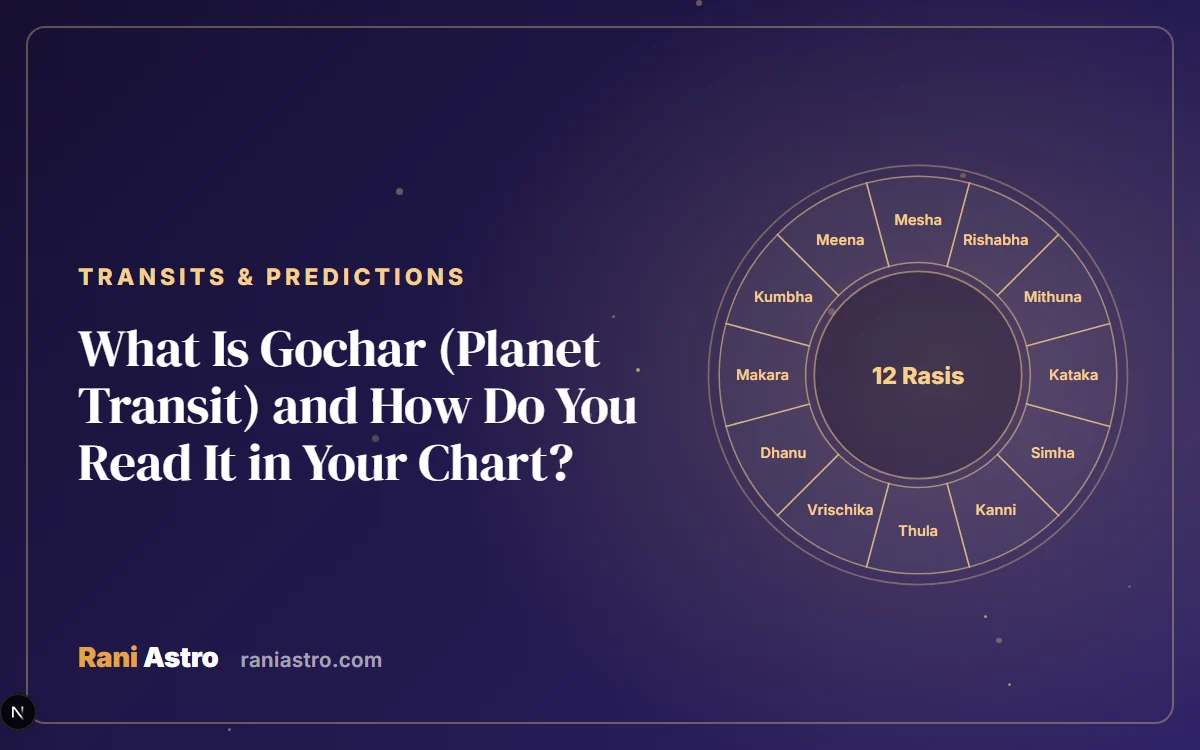
Gochar is the movement of the planets through the twelve rasis today, read against your birth chart. Astrologers count where each planet is now from your birth Moon sign. Saturn takes about two and a half years to cross one rasi and Jupiter about one year, so their gochar shapes long stretches of life.
Your birth chart is a photograph of the sky at one minute. Gochar is the sky moving on after it. Every weekly rasi palan in a newspaper, every Sani peyarchi booklet sold outside a temple, is a gochar reading.
Free tool: Planet Positions Today. Where every graha is now, which are retrograde, and the next sign changes.
What Does Gochar Mean?
Gochar (gochara in Sanskrit) is the Vedic astrology term for planetary transit, the current position of the nine grahas compared with their positions at your birth. Tamil uses the word peyarchi, meaning a shift, which is why people say Guru peyarchi and Sani peyarchi. In Telugu, Kannada and Malayalam you will hear gochara or gocharam, and gochara phalam for its results.
The idea is simple. Your birth chart does not change. The planets keep moving. When a moving planet passes over a sensitive point in your chart, astrologers expect that part of life to stir.
How Long Does Each Planet Stay in One Rasi?
Gochar works on different clocks because the planets move at very different speeds. The Moon changes rasi every two days or so. Saturn sits in one rasi for years. That is why nobody worries about a Moon transit for long, and why a Saturn transit gets a whole booklet.
| Planet | Time in one rasi, roughly | Time to go round all 12 rasis |
|---|---|---|
| Moon (Chandra) | about 2.25 days | about 27 days |
| Sun (Surya) | about 1 month | 1 year |
| Mercury (Budha) | about 1 month, longer when retrograde | about 1 year, as it stays near the Sun |
| Venus (Shukra) | about 1 month, up to about 4 months when retrograde | about 1 year |
| Mars (Sevvai, Mangal) | about 1.5 to 2 months, much longer when retrograde | just under 2 years |
| Jupiter (Guru) | about 1 year | about 12 years |
| Saturn (Sani, Shani) | about 2.5 years | about 29.5 years |
| Rahu and Ketu | about 18 months, always moving backwards | about 18.6 years |
Notice the last row. Rahu and Ketu always move in reverse through the zodiac, and they always sit exactly opposite each other. When Rahu enters a rasi, Ketu enters the seventh rasi from it on the same day.
Why Gochar Is Read from Your Moon Sign
Most Indian astrologers read gochar from the Chandra rasi, the sign the Moon was in when you were born. The Moon is the mind in Jyotish, and transits are felt through the mind first. All the rasi palan you see in Tamil and Telugu calendars are written this way, twelve paragraphs for twelve Moon signs.
Lagna gochar is the other method. Here the astrologer counts the transit from your lagna (ascendant) instead of the Moon. It is more personal, because two people with the same rasi can have very different lagnas, and so a transit falls in a different house for each. Many astrologers in North India look at both, and give more weight to whichever of the two is stronger in the chart.
One warning before you compare apps. Western astrology uses the tropical zodiac, and Vedic astrology uses the sidereal zodiac, which today sits about 24 degrees behind. So a Western app may show Saturn in one sign while your panchang shows it in the sign before. Both are counting correctly. They are counting from different starting points.
Which Houses from the Moon Are Good for Each Planet?
The classical gochar rules, found in texts such as Phaladeepika, list the houses from your Moon sign where each planet gives good results. Outside these houses the planet is read as neutral or troublesome.
| Planet | Good houses from the birth Moon |
|---|---|
| Sun | 3, 6, 10, 11 |
| Moon | 1, 3, 6, 7, 10, 11 |
| Mars | 3, 6, 11 |
| Mercury | 2, 4, 6, 8, 10, 11 |
| Jupiter | 2, 5, 7, 9, 11 |
| Venus | 1, 2, 3, 4, 5, 8, 9, 11, 12 |
| Saturn | 3, 6, 11 |
| Rahu and Ketu | 3, 6, 11 |
The table is the starting point, never the whole reading. Classical gochar also uses vedha, a rule where a planet in a particular other house blocks the good result of a transit. Many astrologers now also check ashtakavarga, a point system where each rasi gets a score of bindus. The twelve rasis share 337 bindus in total, so 28 is about average.
A slow planet passing through a rasi with more than 28 bindus is expected to do better than the house alone suggests.
A small example. Suppose your rasi is Kataka (Cancer, Katakam in Tamil) and Jupiter enters Kanni (Virgo). Kanni is the 3rd from Kataka, which is not in Jupiter's good list.
When Jupiter moves on to Thula, the 4th, it is still outside the list. Only in Vrischika, the 5th from Kataka, does Jupiter reach a good house again. That is how a palan writer decides whether a Guru peyarchi is "good" or "average" for a rasi.
Shani Gochar, the Transit People Fear Most
Shani gochar is Saturn's transit through the rasis, and because Saturn stays about two and a half years in each sign, its effects are slow and long. Three positions from the Moon get special names.
| Saturn's position from your Moon | Name | Length |
|---|---|---|
| 12th, 1st and 2nd | Sade sati, ezharai sani (elarai sani) in Tamil | about 7.5 years |
| 4th | Ardhashtama sani, part of Shani dhaiya in North India | about 2.5 years |
| 8th | Ashtama sani, the other part of Shani dhaiya | about 2.5 years |
Saturn is also good in the 3rd and 6th from the Moon, and best of all in the 11th. A person in one of those often has a busy, productive stretch. People forget this half. Our page on Sani peyarchi and its effects for each rasi covers all twelve signs, and Saturn transit 2027 covers the next change.
We do not print transit dates on this page, on purpose. They are checked separately for each transit post.
Guru Gochar and Guru Balam
Jupiter's transit decides a lot of family plans in South India. Tamil families fixing a wedding often ask whether the bride and groom have Guru balam, meaning Jupiter is in the 2nd, 5th, 7th, 9th or 11th from their Moon sign. These are the same good houses in the table above.
Because Jupiter spends about a year in each rasi, every Guru peyarchi reshuffles which rasis have Guru balam for the next year. That is why Guru peyarchi palangal are among the most read pages in Tamil astrology every year, and why the Jupiter transit 2026 page is written rasi by rasi.
Jupiter also aspects the 5th, 7th and 9th houses counted from where it stands. So a Jupiter in the 3rd from your Moon, which is not a good house, still casts its 7th aspect on the 9th house from your Moon.
Rahu and Ketu Gochar
Rahu and Ketu change rasi about every 18 months. They always move together, and always backwards. In the classical rules both do well in the same houses from the Moon as Saturn (see the table above). Their transit over the Moon itself, or over the lagna, is the one most astrologers watch, as it tends to bring confusion and sudden turns while it lasts.
Tamil readers know this as Rahu Ketu peyarchi. See Rahu Ketu peyarchi 2026 for the Tamil palangal and Rahu Ketu transit 2026 for the effects by rasi.
Fast Planets, Retrograde Periods and Chandrashtamam
The Sun, Mercury, Venus and Mars move quickly, so their gochar colours weeks and months, not years. Retrograde (vakri) periods get attention because a planet seems to move backwards and may re-enter the sign it just left. The Sun and Moon never go retrograde. Rahu and Ketu are always retrograde.
Mercury turns retrograde about three times a year, for roughly three weeks each time, and astrologers advise extra care with contracts and messages then. Venus turns retrograde less often, about once in 18 months, for around six weeks, and that period is read for love and money. Our pages on Mercury retrograde 2027 and Venus retrograde 2027 list what people usually postpone.
The Moon's gochar is the fastest of all. Chandrashtamam is the two and a quarter days each month when the Moon passes through the 8th rasi from your birth Moon. Most Tamil daily calendars print the chandrashtamam stars for each day, and many families avoid starting anything new on those days.
Gochar and Dasha, Which One Decides?
Dasha decides, and gochar triggers. That is the rule most astrologers follow. The Vimshottari dasha tells you which planet's period you are running and what the chart has promised for that period. The transit shows when, inside that period, the promise is likely to show up.
So two people with the same rasi, going through the same Sani peyarchi, can have very different years. One may be in a strong Jupiter dasha. The other may be in a difficult Saturn bhukti. The newspaper palan cannot know this. Your own chart can.
How to Read Gochar in Your Own Chart
- Find your birth rasi (Moon sign) and your lagna. Both are in any jathagam or kundli.
- Note today's rasi for each slow planet: Saturn, Jupiter, Rahu and Ketu. Any panchang has this.
- Count from your rasi to the rasi each planet is in now. Count your own rasi as 1.
- Check that number against the good houses table above.
- Repeat the count from your lagna, to see which house of life the transit is passing.
- Look at your running dasha and bhukti before deciding how much the transit will matter.
- For a big decision, check the ashtakavarga bindus of the rasi the slow planet is in.
Here is step 3 done once. Your rasi is Meena (Pisces). Saturn is in Mesha (Aries). Count Meena as 1, so Mesha is 2. Saturn in the 2nd from the Moon is the last phase of sade sati.
Why Two Calendars Can Give Two Peyarchi Dates
In Tamil Nadu you may see two different dates for the same Sani or Guru peyarchi. One comes from the Vakya panchangam, the older traditional method of calculation. The other comes from the Thirukanitha panchangam, which follows modern astronomical calculation. The gap between them can be weeks, sometimes months.
Neither side is lying. Temples and families follow the panchang their tradition follows (the Thirunallar Saneeswaran temple, for example, is known to follow the Vakya panchangam for Sani peyarchi). If your family astrologer uses one system, stay with it for your own readings. Our monthly horoscope guide explains how the shorter palan are worked out from the same counts.
What Families Do During a Difficult Gochar
There is no remedy that stops a planet from moving. What families traditionally do is keep up worship of the planet concerned through the hard stretch. For Saturn that means Saturday prayers and a sesame oil lamp. Many also pray to Hanuman or Lord Shiva on Saturdays, or visit a Saturn temple. For Rahu and Ketu it often means a Rahu kalam lamp to Durga.
Most astrologers we know also give a plainer piece of advice. A difficult transit is a time to avoid unnecessary risks, not a time to panic. Keep big gambles for a better period, and look after health and sleep.
Want to see how the coming transits fall on your own chart, not just your rasi? Our Lifetime Horoscope Report (₹249) includes your dasha and bhukti periods and a year-by-year view of the next ten years. For the year-by-year picture for all rasis, start with our guide to planet transits in 2027.
Common Questions
What Is Gochar in Simple Words?
Gochar is where the planets are in the sky now, compared with where they were when you were born. Astrologers read it mainly from your birth Moon sign.
What Is the Difference Between Gochar and Dasha?
Dasha is the planetary period you are running, fixed from your birth star. Gochar is the planets' current movement. Dasha shows what is promised, and gochar shows when it is likely to happen.
What Is Lagna Gochar?
Lagna gochar is reading a transit from your ascendant instead of your Moon sign. It tells you which house of life the planet is passing through in your own chart.
Why Is Shani Gochar Given So Much Importance?
Saturn stays about two and a half years in each rasi, so its transit covers long stretches of life. Three of its positions in a row make up sade sati, which lasts about seven and a half years.