Vastu for Main Door, Where the Entrance Should Be and How to Fix It
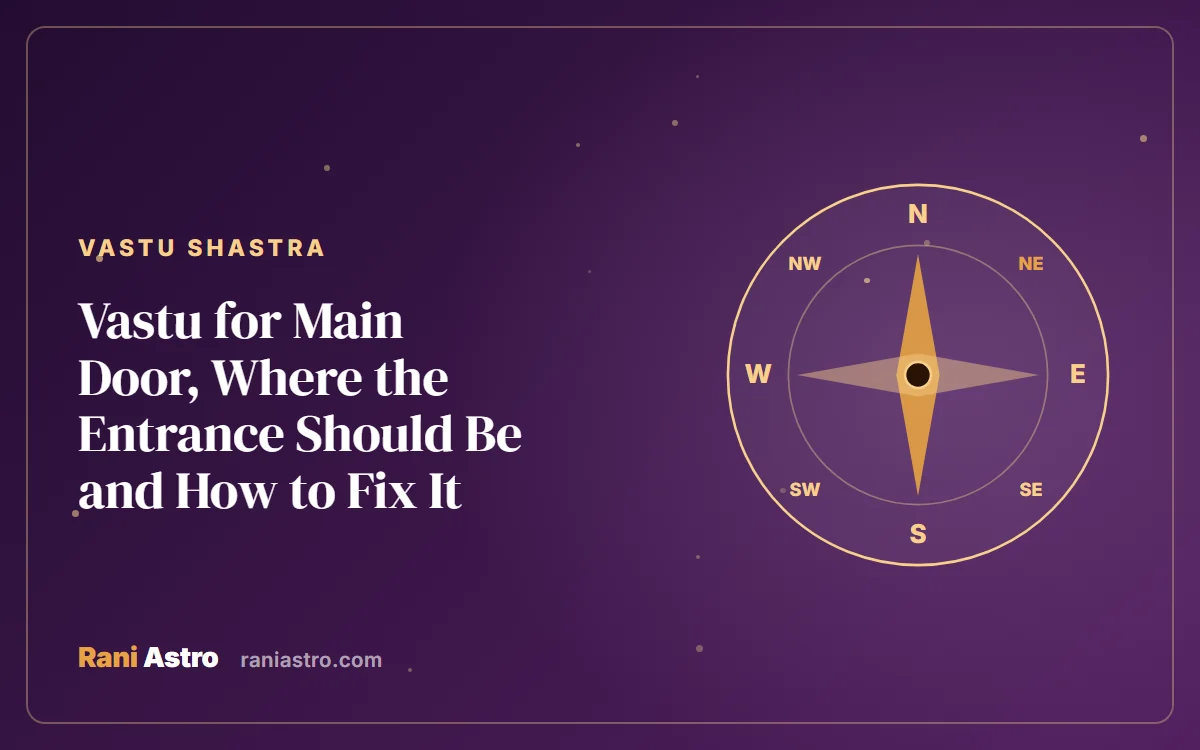
Vastu for main door starts with direction. A main door on the north or east side of the house is the most favoured. A door on the south or west can also be good, as long as it sits in the right part of that wall and away from the south-west corner. The door should open inward and be the largest door in the house.
The main door is the first thing vastu looks at. Older people call it the mouth of the house, because everything that enters the home comes through it.
Free tool: Vastu Calculator. Your main door's square among the 32 entrance padas, and a room check.
Why the Exact Position Matters More than the Facing
The old method divides each side of the house into eight parts, called padas, which makes 32 around the house. Each pada has its own deity, and some are counted as good places for a door while others are not. That is the reason a south-facing house is not bad by itself. Its door may sit in a good pada.
The trouble is that books and regions do not all agree on which padas are best. A sthapati trained in the Tamil tradition and a consultant using a North Indian book may mark slightly different spots. So most consultants today use a simpler rule that both sides accept: on any wall, move the door away from the south-west end.
| House facing | Where on that wall the door is usually preferred | Part to avoid |
|---|---|---|
| East | Towards the north-east half, not right at the corner | The south-east end |
| North | Towards the north-east half, not right at the corner | The north-west end |
| South | Towards the south-east half | The south-west half |
| West | Towards the north-west half | The south-west half |
Vastu for Main Door, South Facing
South-facing houses worry families more than any other. Many people have been told a south door brings trouble, because the south is the direction of Yama. The vastu books we know do not say that. They say the door should sit in the south-east part of the south wall and stay clear of the south-west.
In our experience, a south-facing house with a well-placed door and a north-east corner kept open is a perfectly good home. South-facing plots are often cheaper for exactly this fear, which is worth knowing if you are buying. Our vastu for plot guide covers how to judge the land itself.
Size, Shape and Design
The main door should be the biggest door in the house, larger than any bedroom or kitchen door. That is the one size rule almost every book agrees on.
Exact heights and widths differ. A lot. Many Tamil families check the door frame against Manaiyadi sastram, a list of good and bad measurements, and Kerala carpenters follow their own Thachu shastra tradition. Ask your carpenter or the person who drew your plan, since the lists vary.
On design, the traditional South Indian main door is solid wood, often teak, with two shutters that open inward and a raised wooden threshold. The frame is often carved with Lakshmi or Ganesha. Many families fix the door frame on an auspicious day with a small pooja, called nilai vaasal vaithal in Tamil, before the walls go up further.
A few points that most vastu books share:
- The door opens inward and clockwise, without creaking.
- It should not open straight onto a wall a step away.
- Glass doors and sliding doors are fine for balconies, but the main door is usually kept solid.
- No broken handle, stuck lock or peeling paint at the entrance.
Vastu for Main Door Steps
Most masons and families prefer an odd number of steps up to the main door, such as three or five. This is a custom more than a measured rule. Steps rise towards the house, so you climb up to enter, and the entrance sits a little higher than the road.
If the house already has an even number of steps, do not break anything for this. A slightly raised platform at the top, or simply leaving it alone, is what most consultants suggest.
What to Avoid in Front of the Door
Vastu calls an obstruction in front of the main door dwara vedha. The usual list is short.
- A road that runs straight into the door. Tamil families call this theru kuthu, and it is the defect they worry about most.
- A pole, a large tree or a pillar directly in line with the middle of the door.
- Another house's door exactly facing yours across a narrow lane.
- The main door and the back door in one straight line, so that you can see straight through the house.
- Shoes, dustbins and old cartons piled at the entrance.
The first three can rarely be changed. A low wall, a gate placed a little to one side, or a row of potted plants is the common way families soften them.
Daily Care of the Entrance
This is where vastu meets what Indian homes have always done. In Tamil Nadu the day starts with a kolam drawn in rice flour at the doorstep. On Fridays many women apply turmeric and kumkum to the threshold. On festival days a thoranam of mango leaves goes up over the frame. In the evening a lamp is lit near the door.
Keep the entrance well lit at night. Fix the doorbell if it is broken. A clean nameplate helps visitors and looks cared for.
When You Cannot Change the Main Door
In a flat, the builder fixed the door. In a rented house you cannot touch it. That is the case for most readers, so here is what helps.
- Keep the area inside and outside the door clean and bright, with no shoe pile in the way.
- Draw a kolam or keep a small rangoli at the threshold.
- Hang a mango leaf or cloth thoranam over the frame.
- If the door is in the south-west, keep the entrance especially well lit and uncluttered, and make sure the north-east of the flat is open and clean.
- Do not cut a new door in a flat for vastu. Walls in a building are a matter for the engineer and the association.
None of this needs a pyramid or a crystal. Those come from feng shui and from shops.
The Main Door, Griha Pravesam and Your Chart
Families usually fix the griha pravesam muhurtham with the main door in mind, since the family enters through it on that day carrying a lamp or a pot of milk. The date comes from the panchang and from the head of the family's chart.
In a horoscope, the 4th house shows the home and its comforts. If you are planning to buy or build, our Lifetime Horoscope Report (₹249) reads your full chart and gives a year-by-year view of the next ten years, which helps you see which years suit property.
For the rest of the house, see the vastu for home guide. For prayer space near the entrance, see vastu for the pooja room.
Common Questions
Which Direction Is Best for the Main Door?
North and east are the most favoured. South and west doors are acceptable when placed away from the south-west part of the wall.
Is a South-Facing Main Door Bad as per Vastu?
No. A south-facing door is fine when it sits in the south-east part of the south wall. The part to avoid is the south-west.
How Many Steps Should There Be at the Main Door?
Most families and masons prefer an odd number, such as three or five. It is a custom, and an even number is not a reason to rebuild.
Should the Main Door Open Inward or Outward?
Inward, and clockwise. Every vastu book we know says the same.
What Should Be Kept at the Main Door as per Vastu?
A clean, well-lit threshold, a kolam, a thoranam of mango leaves and a working light. Keep shoes and dustbins away from the door.