Sanyasa Yoga in a Horoscope, What the Texts Say and How to Find It in Your Chart
Sanyasa yoga (also called Pravrajya yoga) forms when four or more strong planets sit together in one sign of the birth chart. The strongest planet in the group decides what kind of renunciation the texts describe. If that planet is combust, close to the Sun, the yoga does not give sanyasa at all.
That rule comes from Varahamihira's Brihat Jataka, which gives renunciation a whole chapter of its own (chapter 15 in the common English editions). Later books such as Saravali and Phaladeepika repeat it and add details.
Most parents who search for this are worried about one thing: will my son or daughter leave home? In our experience the honest answer is almost always no. The rest of this page explains why.
What the Classical Rule Says
The core of Sanyasa yoga is a crowd of planets. Four or more of the seven classical planets (Sun to Saturn) in a single sign make a person look past ordinary life, according to the old texts. Rahu and Ketu are not part of the original rule, because the yoga was written before they were counted this way.
Then comes the deciding step. The texts look at which planet in the group is the strongest, and each planet gives a different picture of the renunciate.
| Strongest planet in the group | The kind of renunciation the texts describe |
|---|---|
| Sun | Austere practice in lonely places, high morals |
| Moon | A quiet, secluded life with study of scripture |
| Mars | Red robes, and a lifelong fight with one's own temper |
| Mercury | Easily drawn to other people's philosophies |
| Jupiter | Mastery over the senses, a teacher's kind of sanyasa |
| Venus | A wandering mendicant |
| Saturn | Very severe penance |
Two more conditions follow. If the strongest planet is combust, the person does not take sanyasa. If it is defeated in a graha yuddha (a planetary war, when two planets sit within a degree of each other), the texts say the person takes vows and later returns to family life.
Some commentators also give extra weight to the lord of the 10th house, the house of karma. When the 10th lord is part of the group, the pull is read as stronger.
Why Most Charts with Four Planets Together Never Make a Monk
Four planets in one sign is not rare. Mercury never moves far from the Sun, and Venus stays within about two signs of it. So the Sun often shares its sign with Mercury and Venus. Every month, for a couple of days near amavasai (new moon), the Moon joins them too.
That gives a four-planet group in plenty of ordinary charts. Most of those people are married, run shops, work in offices and have no plan to renounce anything.
The text itself explains this. In a group that includes the Sun, the other planets are often combust, and a combust strongest planet cancels the yoga by Varahamihira's own rule. The word "strong" in the definition also does real work. Planets in debilitation, in an enemy sign or very low in strength do not count for much.
So a true Sanyasa yoga needs four or more planets in one sign, at least one of them clearly strong, and that strong one free of combustion. That is a much smaller set of charts.
How to Find Sanyasa Yoga in Your Horoscope
You can check this with a printed jathagam or a free chart in about ten minutes.
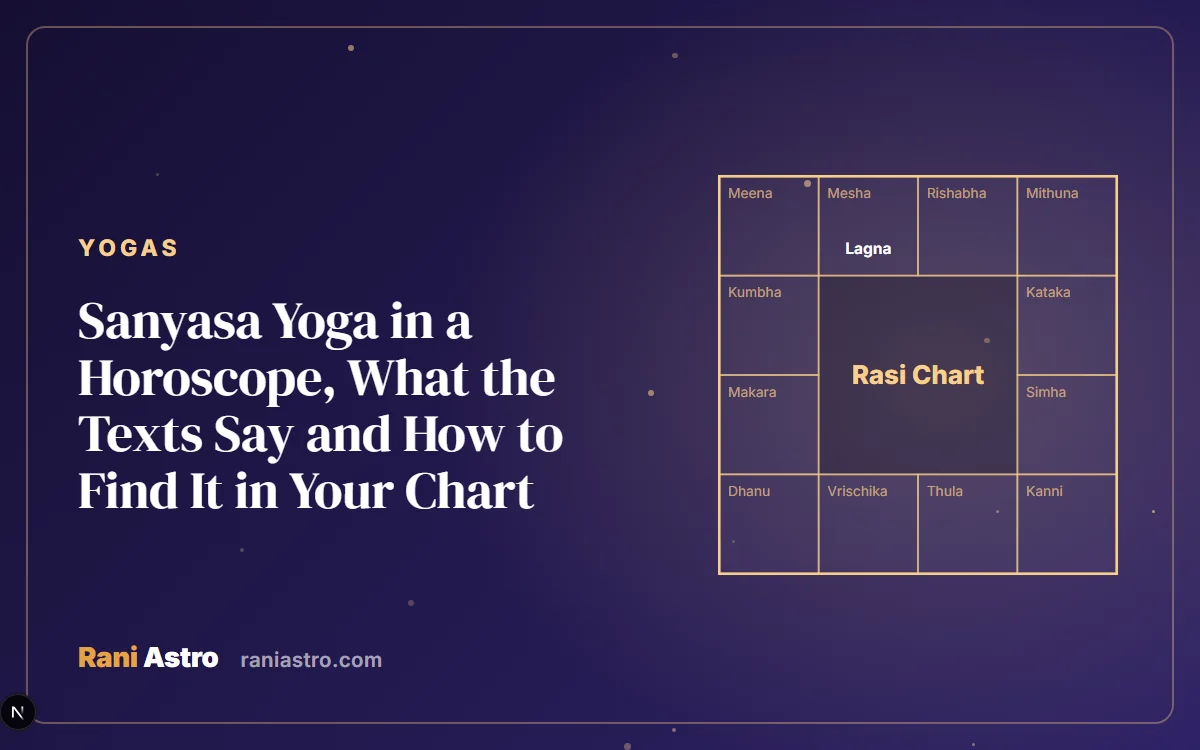
- Count the planets in each sign of the rasi chart. Use only the Sun, Moon, Mars, Mercury, Jupiter, Venus and Saturn.
- If no sign has four or more, there is no classical Sanyasa yoga. Stop here.
- If one does, list the planets in it and their degrees.
- Mark any planet within about 10 to 12 degrees of the Sun as combust. Exact limits differ by planet and by text.
- Pick the strongest planet. Own sign or exaltation, a good navamsa and freedom from combustion all count. Astrologers who use shadbala (the six-fold strength score) take it from there.
- If that planet is combust, the yoga is cancelled.
- Check whether the group sits in a kendra or a trikona, and whether the 10th lord is in it.
Software reports often flag "Pravrajya yoga" the moment four planets meet. Steps 4 to 6 are where the flag usually falls apart.
Ketu, Saturn and the 12th House, the Modern Additions
Modern astrologers rarely stop at the classical rule. Many read detachment from Ketu in the 12th house, from Saturn's aspect on the Moon, or from a strong link between the 12th house (moksha and letting go) and the lagna. A rule commonly quoted from the old texts says the lord of the Moon sign, aspected by Saturn alone, also leans a person towards renunciation.
These are reasonable readings of a detached temperament. They are not Sanyasa yoga in the strict sense, and astrologers disagree on how much weight to give them. If someone tells you "Ketu in the 12th means sanyasa", ask which text they are using.
What It Looks Like in a Householder's Life
For most people with some of these features, the yoga shows as a temperament. They are less excited by money and status than their cousins. They are pulled towards temples and long pilgrimages to Sabarimala or Kailash. Some sit with the Gita every morning. Some become teachers or counsellors. Some marry late. Plenty marry at the normal age and are fine husbands and wives with a strong inner life.
A Jupiter-led group fits a teacher well. A Saturn-led one often fits a person who does hard, lonely, disciplined work for years. Our page on Hamsa yoga covers the Jupiter side of this in more detail.
The Dasha Has to Switch It On
Like every yoga, Sanyasa yoga shows its results mainly in the dasha (dasai) and bhukti of the planets that form it. A Saturn-led group with Saturn's 19-year mahadasha falling in a person's forties will show very differently from one whose Saturn dasha ran in childhood. Many people with a real Pravrajya pattern simply become more spiritual in that period and then carry on with family life.
What Families Can Do
Nothing needs to be "fixed". Sanyasa yoga is not a dosham, and the texts treat it as a good yoga for the soul. If a parent is anxious before a marriage, have the whole chart read. That means the 7th house and its lord with Venus and the navamsa, plus the dasha running at the planned age of marriage. That answer tells you far more than one yoga.
Our guide to yogas in a horoscope explains how yogas are weighed against each other, and the page on Raj yoga covers the kendra and trikona links mentioned above. If you want your own chart checked, our Lifetime Horoscope Report (₹249) lists the yogas and doshas in your chart with every dasha and bhukti period, sent as a PDF on WhatsApp in your language.
Common Questions
How Do I Find Sanyasa Yoga in My Horoscope?
Look for four or more of the seven planets in one sign. Then find the strongest of them and check that it is not combust. If it is combust, the classical yoga is cancelled.
Does Sanyasa Yoga Mean the Person Will Not Marry?
No. Most people with this pattern marry and live ordinary family lives. Marriage is read from the 7th house, Venus and the navamsa, with the dasha.
Is Pravrajya Yoga the Same as Sanyasa Yoga?
Yes. Pravrajya is the name Varahamihira uses. Sanyasa yoga is the common name today.
Do Rahu and Ketu Count in Sanyasa Yoga?
Not in the classical rule, which uses the seven planets from the Sun to Saturn. Modern astrologers often read Ketu as a sign of detachment, but that is a separate reading.