Ketu Mahadasha Rahu Antardasha, What to Expect When Both Nodes Run Together
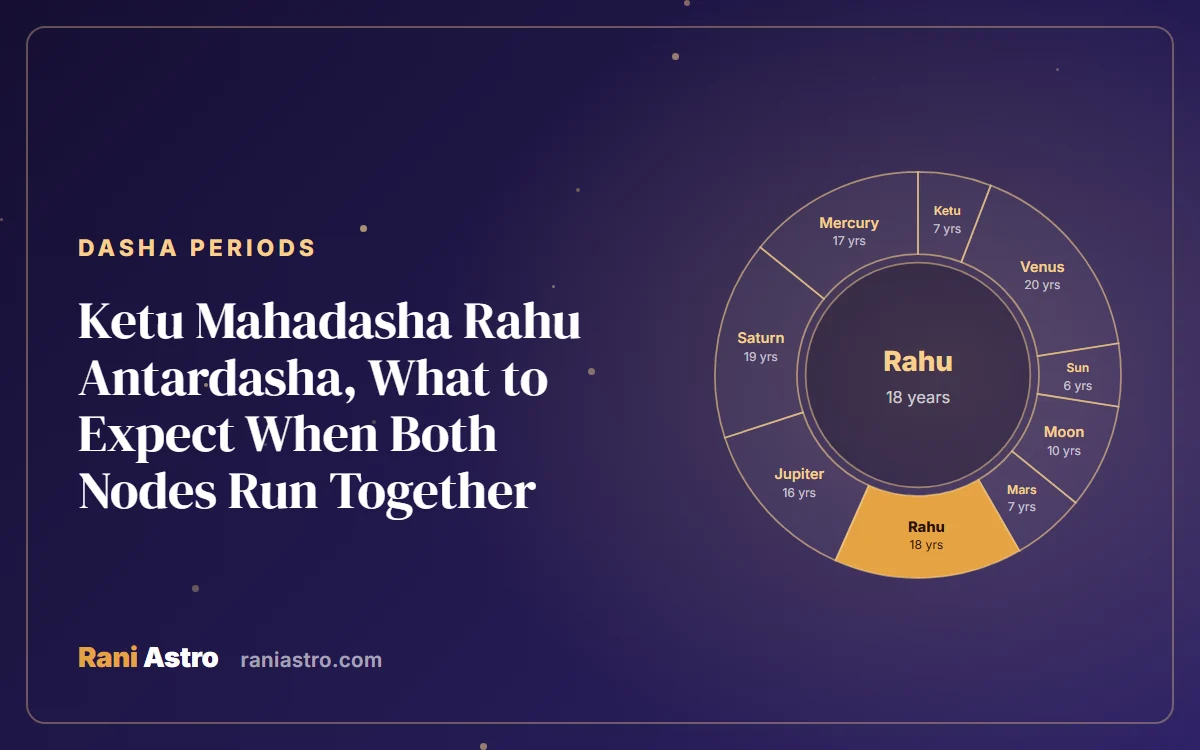
Ketu mahadasha Rahu antardasha is the sixth sub-period of Ketu's 7-year dasha, and it lasts 1 year 0 months 18 days. The sum is 7 x 18 / 120 = 1.05 years. In Tamil it is Kethu dasai Raagu bhukti. It begins 2 years 11 months after Ketu mahadasha starts and ends at 3 years 11 months 18 days.
This is the only stretch in the whole 120-year Vimshottari cycle, apart from its mirror image in Rahu's dasha, where the two shadow planets share the clock. That alone makes families sit up when they see it in the jathagam.
Free tool: Dasha Calculator. Your running mahadasha and antardasha, with the full 120-year table.
Where the Rahu Bhukti Falls in Ketu's Seven Years
Every mahadasha starts with its own planet's bhukti and then runs through the others in the fixed Vimshottari order. Ketu's dasha is short, so all nine bhuktis are short too. We worked out each one as 7 x (sub-period years) / 120 and used 30-day months, as most panchang tables do.
| Bhukti in Ketu dasha | Length | Runs from (years into Ketu) |
|---|---|---|
| Ketu | 4 months 27 days | 0 |
| Venus (Sukran) | 1 year 2 months | 4 months 27 days |
| Sun (Suriyan) | 4 months 6 days | 1 year 6 months 27 days |
| Moon (Chandran) | 7 months | 1 year 11 months 3 days |
| Mars (Sevvai) | 4 months 27 days | 2 years 6 months 3 days |
| Rahu (Raagu) | 1 year 0 months 18 days | 2 years 11 months |
| Jupiter (Guru) | 11 months 6 days | 3 years 11 months 18 days |
| Saturn (Sani) | 1 year 1 month 9 days | 4 years 10 months 24 days |
| Mercury (Budhan) | 11 months 27 days | 6 years 0 months 3 days |
Add the column and you get exactly 7 years. Only the Venus and Saturn bhuktis run longer than Rahu's here. It sits right after the short, sharp Ketu mahadasha Mars antardasha and just before the gentler Ketu mahadasha Jupiter antardasha.
Why This Pairing Reads Differently
Rahu and Ketu are the two lunar nodes, the points where the Moon's path crosses the Sun's. They are always exactly opposite each other in the chart. So in this bhukti the sub-lord sits in the 7th house counted from the mahadasha lord, every single time, for every person.
Classical writers treat Ketu as the planet of detachment and loss of interest in worldly things. It is the moksha karaka. Rahu is the opposite pull. He wants more, and he wants what is new or foreign. Put them together and many astrologers describe a year of mixed signals. One part of the person wants to drop everything. The other wants to grab something big.
Neither node owns a sign in the classical scheme, and their exaltation signs are disputed between traditions. So a jothidar reads them through the house they sit in and the lord of that house. That is why two people in the same bhukti can describe opposite years.
Who Meets This Bhukti, and at What Age
Your birth star decides when Ketu mahadasha arrives. Add 2 years 11 months to that and you have the start of this bhukti.
People born in Ashlesha (Ayilyam), Jyeshtha (Kettai) or Revati (Revathi) start life in Mercury's dasha, so Ketu arrives between birth and age 17. For them, Ketu-Rahu can fall in school years. Those born in Pushya (Poosam), Anuradha (Anusham) or Uttara Bhadrapada (Uthirattathi) get Ketu between 17 and 36, which can put this bhukti right into the years of a first job and marriage talks.
Born in Punarvasu, Vishakha or Purva Bhadrapada? Ketu comes between 36 and 52, often when children are growing and a home loan is running. For Ardra, Swati and Shatabhisha it comes later, between 52 and 70. And those born in Ashwini, Magha (Makam) or Moola (Moolam) start life in Ketu itself, so they may meet this bhukti as small children or may already have passed it at birth.
Career and Money
Rahu in the 10th or 11th house, or with the lord of either, is the reading astrologers like most here. Rahu deals in the unusual. Think of a foreign company, a software job or an export business. Or a sudden promotion that comes with a transfer to Bengaluru or Dubai. A job change in this year is a common reading.
The other side is impatience. Ketu's dasha already loosens a person's attachment to a job. Rahu's bhukti can turn that into a sudden resignation without a plan. Most astrologers we know advise against big unplanned money moves here, such as a share punt or a chit fund, when Rahu sits in the 8th or 12th.
Income through the spouse's family or through a partner is also read when Rahu is in the 7th.
Marriage, Family and the Mind
Because the two nodes face each other across the chart, they always sit on one axis of houses, such as the 1st and 7th or the 2nd and 8th.
When Rahu is in the 7th, this bhukti can bring a proposal from an unexpected side: a different city, a different language, a family the parents did not know before. In Tamil Nadu, astrologers also check Rahu-Ketu dosham (sarpa dosham) for a marriage in this period.
For the married, the year can feel restless. One partner may want a move or a new business while the other wants things to stay as they are.
The mind is where many people feel this bhukti most. Ketu dulls interest, Rahu stirs worry. Sleep and focus are what people often mention. Astrology cannot diagnose anything. If anxiety is real, see a doctor, and treat the chart only as background.
How Astrologers Time Events Inside the Year
A twelve-month bhukti is short, so jothidars narrow it down in three steps:
- They read the house Rahu occupies, and the lord of that house, counted from the lagna and from the Moon.
- They split the bhukti into nine pratyantar periods of 7 x 18 x (planet's years) / 14,400 years each. Venus gets the longest, about 2 months 3 days. The Sun gets the shortest, about 19 days.
- They check transits. Rahu and Ketu move backwards through the zodiac, about 18 months in each sign. A transit over the natal Moon in this year gets extra weight.
Look at the opposite pairing too. The Rahu mahadasha has its own Ketu bhukti of the same length, 1 year 0 months 18 days, but there Rahu is the master and Ketu the guest.
Remedies Families Follow
The traditional remedies are simple. Ketu is worshipped through Lord Ganesha, so many families offer a Ganapathi homam or start each day with a Ganesha prayer. Rahu is linked to Goddess Durga, and Durga worship during Rahu kalam is common in Tamil Nadu.
Two Navagraha temples near Kumbakonam belong to the nodes: Thirunageswaram for Rahu and Keezhperumpallam for Ketu. In Andhra Pradesh, the Rahu-Ketu puja at Srikalahasti is the well-known choice. Hessonite (gomedh) is Rahu's gem and cat's eye (vaidurya) is Ketu's. Both are strong stones. Wear either only after your chart has been checked, because the wrong node stone is a common complaint.
Your Own Dates
Your bhukti dates depend on your birth star and how far the Moon had travelled through it at birth. Our Lifetime Horoscope Report lists every mahadasha and bhukti from birth with exact dates, with readings on work and marriage for your chart. It costs ₹249 and comes as a PDF on WhatsApp.
The full system, with every mahadasha, is in our Vimshottari dasha guide, and the parent period is covered in Ketu mahadasha.
Common Questions
How Long Is Ketu Mahadasha Rahu Antardasha?
1 year 0 months 18 days. The formula is 7 x 18 / 120 = 1.05 years.
Is Ketu-Rahu the Same as Rahu Mahadasha Ketu Antardasha?
The length is the same, 1 year 0 months 18 days. The period is different, because in Rahu mahadasha Rahu is the main planet and the Ketu bhukti falls 10 years 6 months into an 18-year dasha.
Which Bhukti Comes After Ketu-Rahu?
Ketu mahadasha Jupiter antardasha, which lasts 11 months 6 days (7 x 16 / 120).
Is This Bhukti Always Bad?
No. Results depend on the houses the two nodes occupy. Rahu in the 3rd, 6th, 10th or 11th is often read as helpful for work and courage.