Mahadasha, Antardasha and Pratyantar Dasha, the Three Levels of Timing
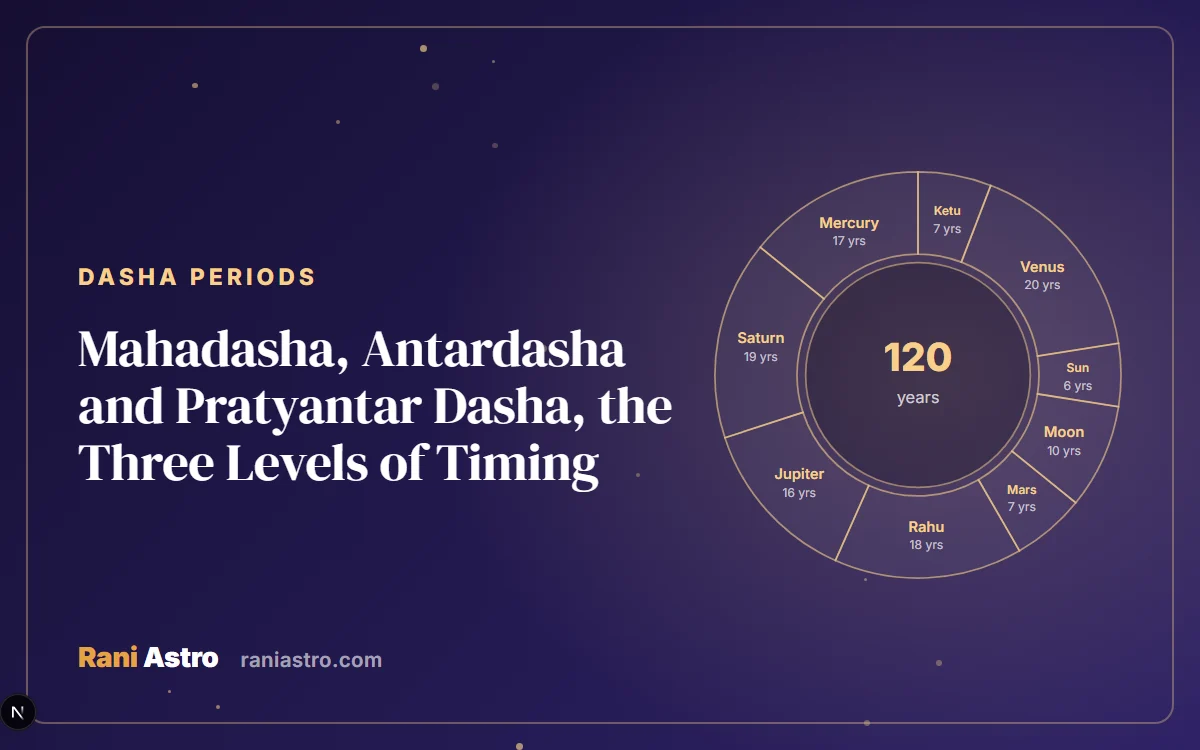
Mahadasha, antardasha and pratyantar dasha are the first three levels of the Vimshottari dasha. A mahadasha is a planet's main period of 6 to 20 years. Each mahadasha splits into nine antardashas, and each antardasha splits again into nine pratyantar dashas. A pratyantar can be as short as about 5 days or as long as 6 months 20 days.
Think of a calendar. The mahadasha is the year, the antardasha the month, and the pratyantar the week. A jothidar reads the big theme from the first, the season from the second and the exact timing from the third.
Free tool: Dasha Calculator. Your running mahadasha and antardasha, with the full 120-year table.
The Names in Different Languages
The same three levels go by different names around India, and it confuses people when two astrologers use two sets of words.
| Level | Sanskrit / Hindi | Tamil | Also called |
|---|---|---|---|
| 1 | Mahadasha | Dasai, thisai | Main period |
| 2 | Antardasha | Bhukti, puthi | Sub-period |
| 3 | Pratyantar dasha | Antharam | Sub-sub-period |
| 4 | Sookshma dasha | Usually the Sanskrit word | Fourth level |
| 5 | Prana dasha | Usually the Sanskrit word | Fifth level |
So when a Tamil jathagam says "Sani dasai, Budhan bhukti, Kethu antharam", that is Saturn mahadasha, Mercury antardasha, Ketu pratyantar. Exactly the same thing.
Why Each Level Exists
The Vimshottari system gives the nine planets fixed years that add up to 120: Ketu 7, Venus 20, Sun 6, Moon 10, Mars 7, Rahu 18, Jupiter 16, Saturn 19 and Mercury 17. The order of the main periods is in our mahadasha sequence page.
The same 120-year proportions are then used again inside each period. Every mahadasha is cut into nine pieces in the same ratio, starting with its own planet. Every piece is cut again in the same ratio. It is the same pattern repeated at a smaller scale each time.
The formulas:
- Antardasha = mahadasha years x antardasha planet years / 120
- Pratyantar = mahadasha years x antardasha years x pratyantar years / 14,400 (that is 120 x 120)
- Sookshma = all four planets' years multiplied / 1,728,000 (120 x 120 x 120)
How Long Each Level Really Is
We worked out the shortest and longest at each level, using a 360-day year as panchang tables do.
| Level | Shortest | Longest |
|---|---|---|
| Mahadasha | Sun, 6 years | Venus, 20 years |
| Antardasha | Sun in Sun, 3 months 18 days | Venus in Venus, 3 years 4 months |
| Pratyantar | Sun-Sun-Sun, about 5 days | Venus-Venus-Venus, 6 months 20 days |
| Sookshma | Sun at all four levels, about 6.5 hours | Venus at all four levels, about 33 days |
| Prana | Sun at all five levels, about 19 minutes | Venus at all five levels, about 5.5 days |
Look at the last two rows. Prana dasha periods can be shorter than half an hour. To use them, the birth time must be correct to the minute, which almost no family's record is. Most astrologers we know stop at the pratyantar, and use sookshma only for a question about a specific week.
A Worked Example, Saturn Mahadasha Mercury Antardasha
Saturn mahadasha is 19 years. Its first antardasha is Saturn's own, and the second is Mercury's:
19 x 17 / 120 = 2.69 years = 2 years 8 months 9 days.
Inside those 2 years 8 months 9 days, the nine pratyantar periods start with Mercury and then follow the usual order:
| Pratyantar (Saturn-Mercury-X) | Sum | Length |
|---|---|---|
| Mercury | 19 x 17 x 17 / 14,400 | 4 months 17 days |
| Ketu | 19 x 17 x 7 / 14,400 | 1 month 27 days |
| Venus | 19 x 17 x 20 / 14,400 | 5 months 12 days |
| Sun | 19 x 17 x 6 / 14,400 | 1 month 18 days |
| Moon | 19 x 17 x 10 / 14,400 | 2 months 21 days |
| Mars | 19 x 17 x 7 / 14,400 | 1 month 27 days |
| Rahu | 19 x 17 x 18 / 14,400 | 4 months 25 days |
| Jupiter | 19 x 17 x 16 / 14,400 | 4 months 9 days |
| Saturn | 19 x 17 x 19 / 14,400 | 5 months 3 days |
Add the nine lengths and you get back 2 years 8 months 9 days. We always do this check.
Software changes the dates slightly depending on whether it uses a 360-day or a 365.25-day year. So two apps may disagree by a few days at the pratyantar level, and by weeks at the mahadasha level. Normal.
How Astrologers Read the Three Together
The mahadasha planet sets the main subject. Saturn's 19 years, for example, are read for work and slow progress, depending on Saturn's houses for your lagna.
The antardasha planet brings its own subjects into that frame, coloured by how it relates to the mahadasha lord. Mercury is a friend of Saturn, so Saturn-Mercury is often read as a good time for business and accounts. Our pages on Jupiter antardasha and Rahu antardasha show how one planet's bhukti changes across different mahadashas.
The pratyantar planet narrows the timing. Say Saturn-Mercury promises a job change. An astrologer may point to the Venus pratyantar (5 months 12 days) or the Jupiter one (4 months 9 days) as the likelier window. It depends on how those planets sit.
All three must agree for a strong result. A good pratyantar inside a hard antardasha gives a few good weeks, not a good year. Transits of Jupiter and Saturn are checked on top of this.
What People Notice When a Level Changes
A new mahadasha is a big shift, and many people feel it within months. A new antardasha is smaller but often noticeable. A new job, perhaps, or a house move. We have a separate page on what happens when an antardasha changes. A pratyantar change usually passes without notice unless something was already due.
This is why we tell people not to watch the pratyantar daily. The levels exist so an astrologer can time an event that the chart already promises. They do not create events on their own.
How to See Your Own Three Levels
Your free birth chart or any good horoscope software lists the mahadasha and antardasha with dates. Many also show the pratyantar if you click into a bhukti. In a printed Tamil jathagam, look for the dasa-bhukti table at the back, usually written by hand by the astrologer.
Our Lifetime Horoscope Report gives every mahadasha and antardasha with exact dates from birth, reads them for your chart, and adds a year-by-year view of the next ten years. It costs ₹249 and comes as a PDF on WhatsApp in 10 Indian languages. The whole system is laid out in our Vimshottari dasha guide.
Common Questions
What Is Mahadasha, Antardasha and Pratyantar Dasha?
They are three levels of the Vimshottari dasha. The mahadasha is a planet's main period, the antardasha is a sub-period inside it, and the pratyantar dasha is a smaller period inside the antardasha.
What Comes After Pratyantar Dasha?
Sookshma dasha, then prana dasha. Each is split in the same 120-year ratio, so they get very short very quickly.
Is Pratyantar Dasha Important?
It is used for fine timing. The mahadasha and antardasha matter more, and the pratyantar only narrows down when something already promised may happen.
Why Does My App Show Slightly Different Dates?
Apps differ in the length of year they use (360 or 365.25 days) and in the ayanamsa. A few days' difference at the pratyantar level is normal.