Divisional Charts D1 to D60, What Each Varga Shows
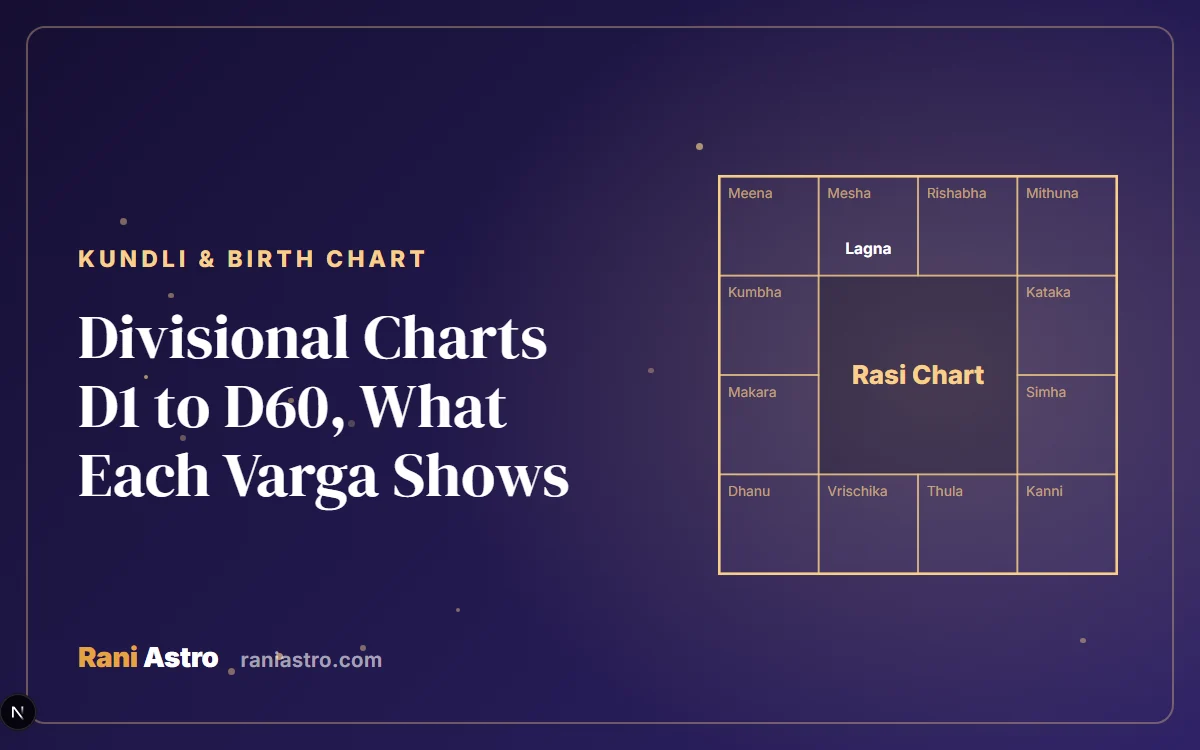
Divisional charts (varga charts) are extra charts made by cutting each 30 degree sign into equal smaller parts and placing each planet by the part it falls in. The navamsa (D9) cuts each sign into 9, the dasamsa (D10) into 10, and the shashtiamsa (D60) into 60. The Brihat Parashara Hora Shastra describes sixteen of them, a set called the shodashavarga.
The main birth chart is the D1, the rasi chart. Each divisional chart zooms in on one area of life, drawn from the same planet degrees.
Free tool: Birth Chart Calculator. Your rasi chart with every planet's degree, star, pada and house.
Why have them at all? Twins born ten minutes apart in the same hospital in Madurai will almost always share the same D1 chart, with every planet in the same sign and house. Yet their lives can turn out quite differently. The divisional charts are the classical answer to that puzzle. They pick up the small differences in degree that the main chart hides.
That is the idea, anyway. Whether it works is for you to judge.
All Sixteen Divisional Charts
The last column is the one people forget. It shows roughly how long the lagna of that chart stays the same, on average. Since the main lagna moves about one degree every four minutes, a chart that slices the sign thinner changes faster.
| Chart | Name | One part is | Read for | Lagna stays same for about |
|---|---|---|---|---|
| D1 | Rasi | 30 degrees | The body and everything in general | 2 hours |
| D2 | Hora | 15 degrees | Wealth | 1 hour |
| D3 | Drekkana | 10 degrees | Brothers, sisters, courage | 40 minutes |
| D4 | Chaturthamsa | 7 degrees 30 minutes | Property, home, fortune | 30 minutes |
| D7 | Saptamsa | about 4 degrees 17 minutes | Children | 17 minutes |
| D9 | Navamsa | 3 degrees 20 minutes | Spouse, dharma, inner strength of planets | 13 minutes |
| D10 | Dasamsa | 3 degrees | Career and status | 12 minutes |
| D12 | Dwadasamsa | 2 degrees 30 minutes | Parents | 10 minutes |
| D16 | Shodasamsa | about 1 degree 52 minutes | Vehicles and comforts | 7 to 8 minutes |
| D20 | Vimsamsa | 1 degree 30 minutes | Spiritual practice | 6 minutes |
| D24 | Chaturvimsamsa (Siddhamsa) | 1 degree 15 minutes | Education and learning | 5 minutes |
| D27 | Saptavimsamsa (Bhamsa) | about 1 degree 7 minutes | Strength and weakness | 4 to 5 minutes |
| D30 | Trimsamsa | unequal parts in Parashari use | Misfortunes and illness | about 4 minutes on average |
| D40 | Khavedamsa | 45 minutes | Good and bad effects, from the mother's side | 3 minutes |
| D45 | Akshavedamsa | 40 minutes | Character and conduct, from the father's side | under 3 minutes |
| D60 | Shashtiamsa | 30 minutes | Past karma, and all matters | 2 minutes |
Two rows deserve a second look. The D60 is given great weight in the classical text, yet its lagna changes every two minutes or so. And the D30 is the odd one out, because Parashara's trimsamsa uses five unequal parts per sign, ruled by Mars, Saturn, Jupiter, Mercury and Venus.
How a Divisional Chart Is Built, with the Navamsa as Example
Each varga has its own rule for which sign the first part of a sign starts from. The navamsa rule is the one most people learn first.
- Divide the sign into 9 parts of 3 degrees 20 minutes each.
- For a movable sign (Mesha, Kataka, Tula, Makara), the first part starts from the same sign.
- For a fixed sign (Vrishabha, Simha, Vrischika, Kumbha), it starts from the 9th sign from it.
- For a dual sign (Mithuna, Kanya, Dhanu, Meena), it starts from the 5th sign from it.
- Count forward through the parts until you reach the planet's degree.
Take Jupiter at 15 degrees of Mesha. Mesha is movable, so its navamsas start from Mesha itself. 15 degrees falls in the fifth part (13 degrees 20 minutes to 16 degrees 40 minutes). Count five signs from Mesha: Mesha, Vrishabha, Mithuna, Kataka, Simha. Jupiter's navamsa is Simha. That is all there is to it.
The other vargas follow rules of the same kind, each with its own starting sign. Software does the counting, so you never need to do it yourself unless you are checking a printout from an old almanac or a website you do not fully trust.
When a planet lands in the same sign in the D1 and the D9, it is called vargottama, and astrologers read that planet as strong and reliable. Our navamsa chart guide goes into this in more depth.
Which Charts Do Astrologers Really Use?
All sixteen exist on paper. In daily practice, most astrologers we know lean on four or five, and some on just two.
The D1 and D9 are read together in almost every reading. Many astrologers will not judge a planet's strength until they have seen where it sits in the navamsa. The D10 chart is the standard one for career questions. The D7 comes up for children and the D12 for parents.
The higher charts, D16 upward, are used mostly by astrologers who have first rectified the birth time. Without that, they risk reading a chart that belongs to someone born five minutes earlier.
Parashara also grouped the charts into sets for judging planetary strength. The shadvarga is six charts (D1, D2, D3, D9, D12 and D30). The saptavarga adds D7. The dashavarga adds D10, D16 and D60 to that. The shodashavarga is all sixteen.
How Exact Does Your Birth Time Need to Be?
Go back to the last column. If your family is sure of the time to within five minutes, D1, D9 and D10 are safe to read. If the time is a round number like 6:00 am or 10:30 pm, treat the D9 and D10 with some caution, and anything from D16 up as unreliable.
Here is a simple test. Make your chart, then make it again with the time five minutes earlier and five minutes later. If the navamsa lagna changes, your time needs checking before anyone reads that chart for marriage.
Seeing Your Own Divisional Charts
Our Free Birth Chart shows your rasi (D1) and navamsa (D9) charts with planet positions, dasha periods, yogas and dosha status, in about a minute after a phone OTP check. Still learning the main chart? Start with our step-by-step kundli guide and the page on your lagna. Every divisional chart has a lagna of its own, read the same way.
Common Questions
Which Divisional Chart Is the Most Important?
After the D1 rasi chart, the D9 navamsa. Astrologers use it to judge every planet's real strength and to read marriage.
What Is the D60 Chart Used For?
The shashtiamsa shows past karma and is given high weight in the classical text. Its lagna changes about every two minutes, so it needs a rectified birth time.
Why Does My Navamsa Change When I Change the Birth Time Slightly?
Each navamsa part of the lagna lasts only about 13 minutes of clock time. A small change in time can move the navamsa lagna into the next sign.
What Is Vargottama?
A planet that sits in the same sign in the D1 and the D9 chart. It is read as strong and steady in its results.