Moon Sign vs Sun Sign, Which One Does Indian Astrology Use?
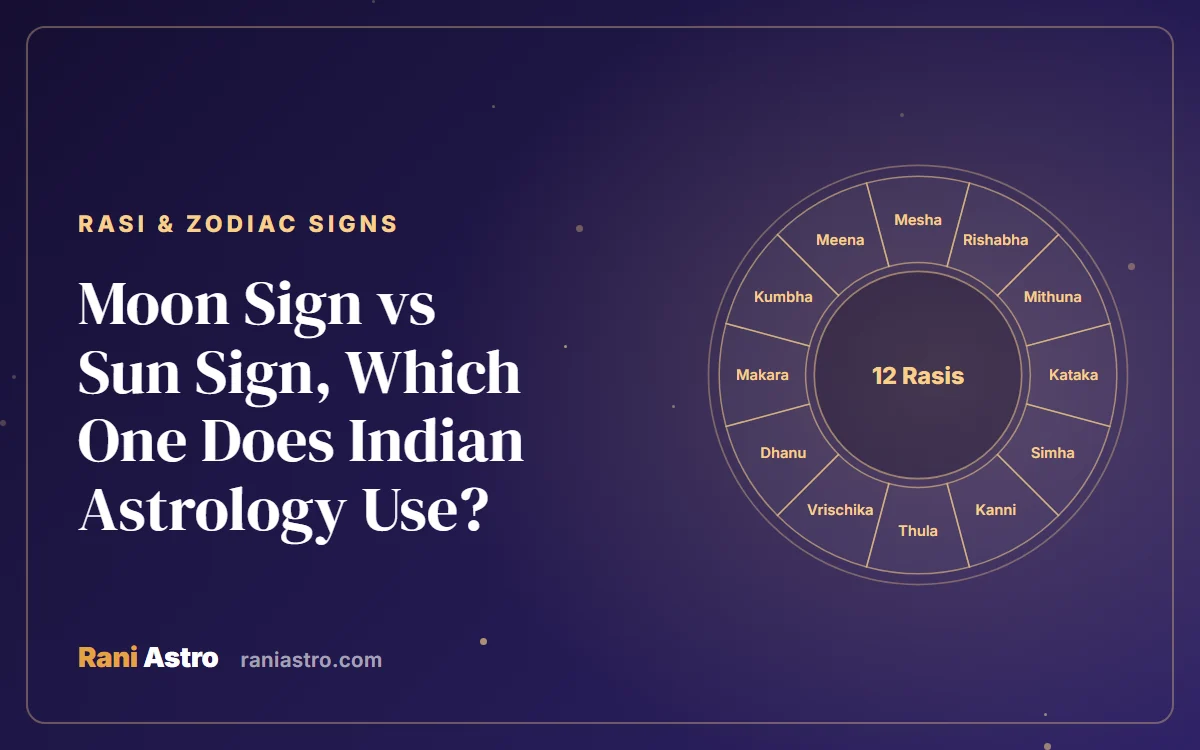
Indian astrology uses the Moon sign. Your rasi is the sign the Moon was in when you were born, and the daily palan is counted from it. So is sade sati. Western astrology uses the Sun sign, the sign the Sun was in, which changes about once a month. The two are often different signs for the same person.
So when a magazine calls you Leo and your grandmother's jathagam (horoscope) says Kataka, nobody has made a mistake. They are reading two different planets.
Free tool: Rasi Calculator. Your Moon sign (rasi) from your birth date, or from your name.
The Short Answer in a Table
| Moon sign | Sun sign | |
|---|---|---|
| Indian name | Rasi, chandra rasi, janma rasi | Surya rasi |
| What it is | The sign the Moon was in at birth | The sign the Sun was in at birth |
| How long the planet stays in one sign | About two and a quarter days | About a month |
| Used mostly by | Indian (Vedic) astrology | Western astrology |
| Zodiac used | Sidereal, measured against the stars | Western sites use the tropical zodiac |
| What you need to find it | Date, and often the time | Date alone, almost always |
The last row explains a lot. A Sun sign is easy to sell in a newspaper because everyone knows their birthday. A Moon sign often needs the birth time, which is why Indian families keep a jathagam or kundli from the day a child is born.
Why Indian Astrology Reads the Moon
The classical Indian texts treat the Moon as the mind (manas). How you feel, how you react, what you worry about at night: astrologers read all of that from the Moon. The Sun stands for the soul and the father. It is read too, but as one planet among nine.
There is also a practical reason. The Moon moves fast, about 13 degrees a day. That makes it a fine clock. The 27 nakshatras (natchathiram in Tamil) are counted along the Moon's path, the Vimshottari dasha starts from the Moon's star at birth, and the chandrashtama days each month come from the Moon's sign. A slow Sun could not do any of this work.
So in an Indian home, "what is your rasi?" means "where was your Moon?" Every time.
Why Your Two Signs Usually Differ
Two separate things push them apart.
The first is simple. The Sun and the Moon are two planets in two places. On a full Moon night they sit opposite each other, six signs apart. On a new Moon day (amavasai) they sit in the same sign. On every other day the gap is somewhere in between.
The second is the zodiac itself. Western astrology starts its Aries at the spring equinox, around 21 March. Indian astrology starts Mesha from a fixed point among the stars. The gap between the two starting points is the ayanamsa, about 24 degrees in 2026 by the Lahiri method that most Indian panchangs follow. That is most of a 30 degree sign.
Take an illustration. Someone is born on 1 April. A Western site puts the Sun in Aries. In an Indian chart the Sun is still in Meena, because the Sun enters sidereal Mesha only around 14 April, the day Tamil Nadu keeps as Puthandu and Kerala as Vishu.
Meanwhile the Moon could be in any of the twelve signs, depending on the day. That one person is "Aries" in the magazine, Meena by the Indian Sun and, say, Mesha rasi by the Moon.
Moon Sign vs Sun Sign vs Zodiac Sign
People search for these three as if they were three different things. They are not quite.
- "Zodiac sign" is the general word for any of the twelve signs. In Western usage it nearly always means your Sun sign.
- "Sun sign" is the sign the Sun was in at your birth.
- "Moon sign" is the sign the Moon was in. In India this is your rasi.
In English-speaking India, "what is your zodiac sign?" can mean either, depending on who is asking. A college friend usually means the Western Sun sign. A family astrologer always means the rasi. If you want the Indian names of each sign next to the English ones, our page on rasi names in English lists them in Tamil, Hindi and Telugu too.
Which Is More Accurate?
Neither, as a general rule, because they answer different questions in different systems. If you follow Western astrology, the Sun sign is its main tool. If you follow Indian astrology, the Moon sign is.
What does not work is mixing them. A Western Sun sign dropped into an Indian method gives a wrong answer, because Indian rules for transits and matching were written for the sidereal Moon. Sade sati counted from a Western Sun sign, for example, is simply counted from the wrong place.
Our own view is plain. If your family follows a jathagam or kundli, use the Moon sign for anything Indian: palan, porutham, naming, sade sati. Read Western Sun sign columns, if you enjoy them, as a separate thing.
Where the Sun Sign Still Matters in India
The Sun is not ignored. It shows up in at least three places most Indians meet every year.
- The Tamil, Malayalam, Bengali and Odia calendars are solar. A Tamil month is the time the Sun spends in one sidereal sign. Chithirai starts when the Sun enters Mesha, Aadi when it enters Kataka, Thai when it enters Makara.
- Makar Sankranti, which Tamil Nadu celebrates as Pongal, is the day the Sun enters Makara.
- In the birth chart, the Sun's house and strength are read for the father, government work and reputation.
So an Indian chart has a Sun sign as well. It is simply not the sign people mean when they say "my rasi".
How to Check Both Signs in Your Own Chart
You can do this in a few minutes.
- Gather the date, the exact time and the place of birth. Without the time, the Moon sign may be uncertain on days when the Moon changed sign.
- Make the chart. Our free birth chart takes about a minute after a phone OTP check and shows the rasi chart with every planet in it.
- Find the box marked Moon, Chandra or "Mo". That box is your rasi.
- Find the box marked Sun, Surya or "Su". That box is your Indian Sun sign.
- Look for the lagna too, marked "Asc" or "La". That is the third sign people confuse with these two.
The lagna (ascendant) is the sign rising in the east at your birth, and it changes about every two hours. Our page on rasi vs lagna vs nakshatra explains how the three work together. The main rasi guide covers how the rasi itself is found and used.
What It Means in Real Life
Say you have been reading "Scorpio" predictions for years, and your chart shows the Moon in Thula. The Indian rasi palan for you is the Thula column, not Vrischika. The chandrashtama days that Tamil families avoid for new work are counted from Thula too. And when Saturn moves, your sade sati is judged from Thula.
The same goes for matching. Rasi porutham in the Tamil system and bhakoot in North Indian guna milan both compare the two Moon signs. A Sun sign compatibility chart from a Western site has nothing to do with either.
None of this makes one rasi better than another, by the way. People often ask us which rasi is powerful, and the honest answer is that strength comes from the whole chart, not from the name of the Moon's sign.
Common Questions
Is Rasi the Same as Sun Sign?
No. Rasi is the Moon sign. Your Sun sign is the sign of the Sun, and in an Indian chart it is often a different rasi altogether.
Why Does My Western Sign Not Match My Indian Chart?
Two reasons. Western astrology uses the Sun while Indian astrology uses the Moon, and the Western zodiac starts about 24 degrees away from the Indian one.
Can I Find My Moon Sign Without the Birth Time?
Often, yes. The Moon stays in one sign for about two and a quarter days, so on many dates the sign is the same all day. On a day when it changed sign, you need at least a rough time.
Which Sign Should I Use for Daily Horoscope in Tamil or Hindi Papers?
Your Moon sign. Indian rasi palan and rashifal columns are written for the rasi, counted from the sidereal Moon.