Samsaptak Yoga in Astrology, How It Forms and What It Gives
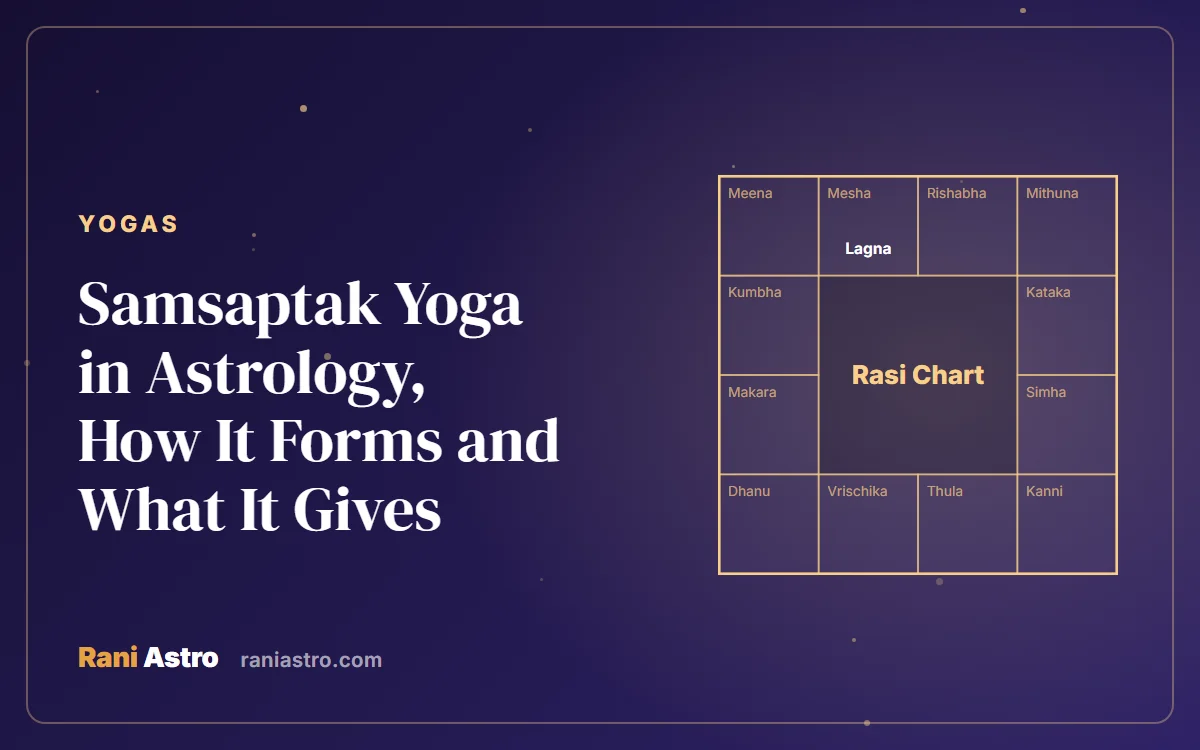
Samsaptak yoga forms when two planets sit in signs exactly seven apart, so that each is in the 7th house from the other. Every planet aspects the 7th sign from itself, so the two look straight at each other. Samsaptak (samasaptaka in Sanskrit) means "seventh to each other". Whether the yoga is good or bad depends on which two planets are facing.
That last line is the honest answer to most searches. Samsaptak yoga is a relationship between planets, not a fixed blessing or curse. Two friends facing each other cooperate. Two enemies facing each other pull in opposite directions.
How to Spot It in a Chart
Count from one planet to the other, including the starting sign. If you reach seven, the two are in samsaptak.
Some pairs of signs that face each other:
| Sign | Faces |
|---|---|
| Mesha (Aries) | Tula (Libra) |
| Vrishabha (Taurus) | Vrischika (Scorpio) |
| Mithuna (Gemini) | Dhanus (Sagittarius) |
| Kataka (Cancer) | Makara (Capricorn) |
| Simha (Leo) | Kumbha (Aquarius) |
| Kanya (Virgo) | Meena (Pisces) |
In astronomy the same picture is called an opposition, when two bodies are 180 degrees apart as seen from Earth. Most Indian astrologers count by sign. A few also want the two planets within a few degrees of exact opposition before they call it strong.
The idea is classical even if the word "yoga" is a later habit. The aspect itself is in every text, and the term samasaptaka is used in matching, where a 7 and 7 rasi pair between the bride and groom is counted as a good bhakoot. Our post on planet aspects explains the full system.
Good or Bad, the Friendship Test
Parashara sorts the other planets into friends and enemies for each planet, with the rest neutral. The table below is the standard list, and it decides how most astrologers read a samsaptak pair.
| Planet | Friends | Enemies |
|---|---|---|
| Sun | Moon, Mars, Jupiter | Venus, Saturn |
| Moon | Sun, Mercury | none |
| Mars | Sun, Moon, Jupiter | Mercury |
| Mercury | Sun, Venus | Moon |
| Jupiter | Sun, Moon, Mars | Mercury, Venus |
| Venus | Mercury, Saturn | Sun, Moon |
| Saturn | Mercury, Venus | Sun, Moon, Mars |
So a Moon and Jupiter samsaptak is read well. In fact it is one of the ways Gaj Kesari yoga forms, since Jupiter in the 7th from the Moon is a kendra from it. A Sun and Saturn samsaptak, or Mars and Saturn, is read as friction: authority against discipline, or energy against delay.
Friendship is only the first filter. Astrologers also ask whether each planet is strong in its sign, and which houses the pair sits in.
Which Houses the Pair Falls In
A samsaptak pair always sits on one of six axes in the birth chart. Each axis has its own theme.
- Houses 1 and 7. Self and spouse. A friendly pair here is read for a well-matched partner; an enemy pair for a marriage where both hold strong opinions.
- Houses 2 and 8. Family money against sudden change and inheritance.
- Houses 3 and 9. Effort against luck, younger siblings against father and teachers.
- Houses 4 and 10. Home against career. This is the axis of the kendras, so planets here are strong.
- Houses 5 and 11. Children and studies against gains and elder siblings.
- Houses 6 and 12. Debts and disputes against expenses and travel.
The Samsaptak That Everyone Has Every Month
Every Purnima is a Sun and Moon samsaptak. On full moon day the Moon is roughly opposite the Sun. A person born on Purnima has this pair in the chart, and it is read as a mind (Moon) and a will (Sun) that look at each other directly.
Rahu and Ketu are always in samsaptak, because they are always exactly opposite. That is why most astrologers do not call the Rahu and Ketu axis a yoga at all. It is the normal state of the nodes.
Samsaptak Yoga in Transits
Many Hindi news sites write about "samsaptak yoga" when two slow planets face each other in the sky. These are transit events that touch every chart, and they are usually read from the Moon sign.
One such pair is due in 2027. By Prokerala's tables (India time, set for Ujjain), Rahu enters Makara on 5 December 2026. Jupiter moves back into Kataka on 25 January 2027 and stays there until 26 June 2027. For those five months the two face each other.
Jupiter is exalted in Kataka. So astrologers will mostly read this as Jupiter's strength meeting Rahu's restlessness, and then look at where Kataka and Makara fall in each person's own chart.
A transit samsaptak lasts weeks or months and passes. A birth chart samsaptak is part of you for life. Do not confuse the two.
What Weakens or Strengthens It
- Exalted or own-sign planets make the pair strong, for good or for friction.
- A combust or debilitated planet in the pair gives a lopsided result, with one side dominating.
- A benefic aspect from Jupiter on either planet softens an enemy pair.
- The dasha of either planet is when the samsaptak becomes active in life.
For other yogas built on how planets surround or face each other, see Kartari yoga and our guide to yogas in a horoscope. If you want every pair in your own chart read together with your dashas, the Lifetime Horoscope Report (₹249) covers planets, aspects, yogas and the next ten years, as a PDF on WhatsApp.
Common Questions
How Is Samsaptak Yoga Formed?
Two planets sit in signs seven apart, such as Mesha and Tula. Each then aspects the other with its 7th-house aspect.
Is Samsaptak Yoga Good or Bad?
It depends on the pair. Natural friends facing each other, like the Moon and Jupiter, are read as helpful. Natural enemies, like the Sun and Saturn, are read as tension between the two areas of life they rule.
Is Samsaptak the Same as Opposition?
Yes, in effect. Western astrology calls it an opposition, measured as 180 degrees. Indian astrologers usually count it by sign, so two planets at 2 degrees of Mesha and 28 degrees of Tula still count.
Do Rahu and Ketu Form Samsaptak Yoga?
They are always opposite each other, so they are always in samsaptak. For that reason most astrologers do not treat it as a special yoga.