Char Dasha in Jaimini Astrology, and How It Differs from Vimshottari
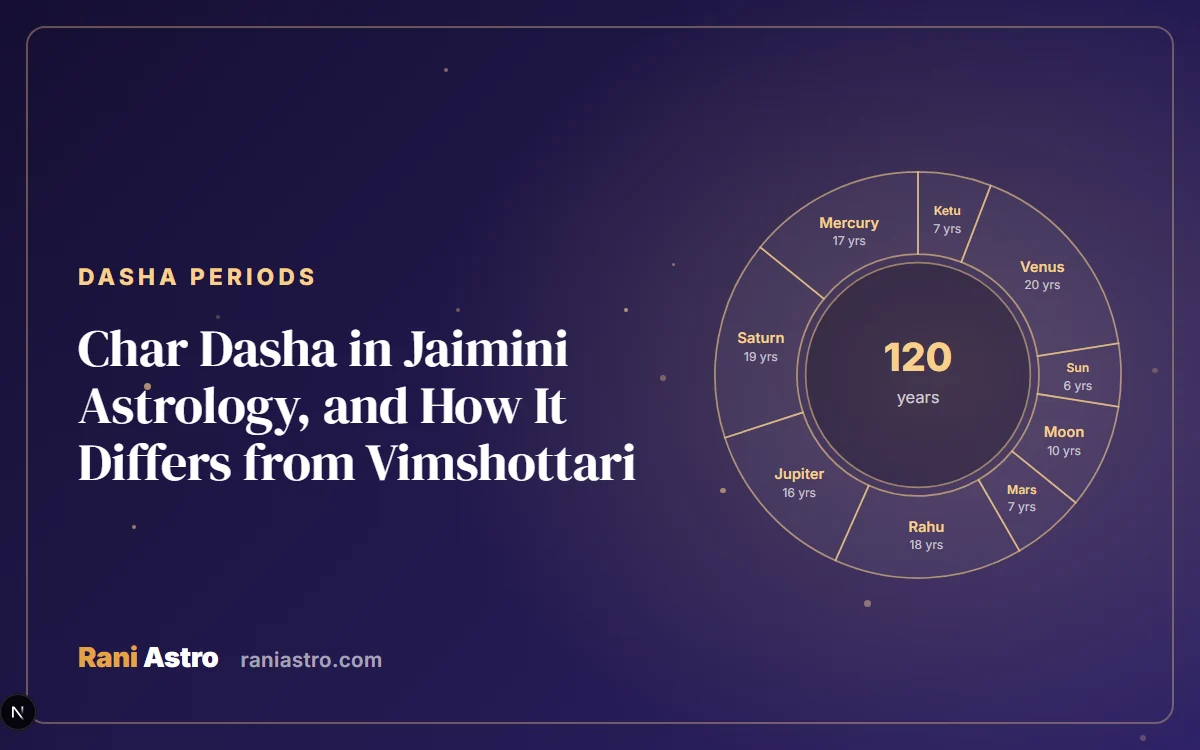
Char dasha (chara dasha) is the main timing system of Jaimini astrology. Here the periods belong to the 12 signs, not to the nine planets. Each sign gets between 1 and 12 years, worked out by counting from the sign to the house where its lord sits. The order starts from the lagna.
That is the big difference from the Vimshottari dasha most Indian families know. Vimshottari hands out fixed years to planets (Venus always 20, Sun always 6) and starts from your birth star. Char dasha has no fixed years at all. Two people born on the same day, a few hours apart, can have completely different char dasha lengths because their lagna and planets fall differently.
Free tool: Dasha Calculator. Your running mahadasha and antardasha, with the full 120-year table.
Where Char Dasha Comes From
The system comes from the Jaimini Sutras, also called the Upadesa Sutras. It is a short, hard text credited to Maharishi Jaimini. The sutras are written in a code of letters and numbers, so every line needs a commentary. That is why astrologers still argue about the exact rules.
Most Indian astrologers who use char dasha today follow the version taught by K. N. Rao and the Bharatiya Vidya Bhavan school in Delhi. Others follow Iranganti Rangacharya or Sanjay Rath, and their methods differ in places. What we describe below is the common version. If your astrologer uses another, the period lengths can come out a year or two different.
How the Length of Each Sign's Period Is Counted
The rule is simple to state. Count from the sign to the sign holding its lord, then take away one. The answer is the number of years.
Whether you count forwards or backwards depends on the sign. In the common version, six signs count forwards and six count backwards.
| Counted forwards (savya) | Counted backwards (apasavya) |
|---|---|
| Mesha (Aries) | Kataka (Cancer) |
| Vrishabha (Taurus) | Simha (Leo) |
| Mithuna (Gemini) | Kanya (Virgo) |
| Tula (Libra) | Makara (Capricorn) |
| Vrischika (Scorpio) | Kumbha (Aquarius) |
| Dhanu (Sagittarius) | Meena (Pisces) |
Three extra rules come up often:
- If the lord sits in its own sign, the period is 12 years, the full count.
- In Jaimini, Vrischika has two lords (Mars and Ketu). Kumbha has Saturn and Rahu. The astrologer picks the stronger of the two by a set of strength rules.
- Many astrologers add one year when the lord is exalted and take away one when it is debilitated.
A Worked Example with Mesha Lagna
Say the lagna is Mesha and Mars, its lord, sits in Simha. Mesha is a forward sign. Counting Mesha as one, Vrishabha two, Mithuna three, Kataka four, Simha five. Five minus one is four. So the Mesha period is 4 years.
Now take Kataka. Its lord is the Moon. Say the Moon is in Mithuna. Kataka counts backwards, so Kataka is one and Mithuna is two. Two minus one gives 1 year. Short.
Say the Sun, lord of Simha, is in Simha itself. That is the own-sign case, so Simha gets the full 12 years.
You can see how uneven it gets. One chart can have a 1-year sign next to a 12-year sign. Nothing like that happens in Vimshottari, where the shortest mahadasha (Sun) is still 6 years.
Which Sign Runs First, and in Which Direction
The first period is the lagna sign. In the K. N. Rao method, the direction of the whole sequence is set by the 9th house from the lagna. If the 9th house falls in a forward sign from the table, the dashas move forward through the zodiac. If it falls in a backward sign, they move backwards.
For Mesha lagna, the 9th house is Dhanu, a forward sign. So the order is Mesha first, then Vrishabha, and on round the zodiac to Meena.
For Kanya lagna, the 9th house is Vrishabha, also forward. For Kataka lagna, the 9th is Meena, a backward sign, so the sequence runs Kataka, then Mithuna, then Vrishabha, in reverse.
Antardashas in char dasha are also signs. Each sign period is split into 12 equal parts, one for each sign. A 12-year Simha period gives 12 sub-periods of one year each. A 4-year period gives 12 sub-periods of four months each.
What Astrologers Read in a Char Dasha Period
A sign period is read through what sits in that sign and what it aspects. Jaimini uses its own aspects. Movable signs aspect the fixed signs except the one next to them, fixed signs aspect the movable signs except the one next to them, and dual signs aspect each other.
The chara karakas carry much of the meaning. These are the planets ranked by their degree within a sign, highest first. The planet with the highest degree is the atmakaraka (the self). Next comes the amatyakaraka (career), then the planets for siblings, mother and children, and two more after them. The darakaraka, the planet with the lowest degree, signifies the spouse.
So when a sign period starts and the darakaraka, or the sign holding it, is involved, Jaimini astrologers look for marriage. When the amatyakaraka's sign runs, they look at career. Some astrologers we know use char dasha mainly to cross-check an event they already see in Vimshottari.
Char Dasha Against the Vimshottari Dasha Chart
| Point | Vimshottari | Char dasha |
|---|---|---|
| Periods belong to | 9 planets | 12 signs |
| Starts from | Birth star (Moon's nakshatra) | Lagna sign |
| Lengths | Fixed, 6 to 20 years | Worked out from the chart, 1 to 12 years |
| Total cycle | Always 120 years | Different for every chart |
| Sub-periods | Antardasha = maha years x sub years / 120 | Each sign period split into 12 equal parts |
| Sensitive to birth time | Through the Moon's degree | Through the lagna, very sensitive |
The last line is the real catch. Char dasha starts from the lagna, which changes about every two hours. A birth time that is 20 minutes off near the edge of a sign can change the whole sequence. Vimshottari is safer with an approximate time, since the Moon moves slowly.
That is the main reason most South Indian jothidars stay with Vimshottari (dasa bhukti) for everyday reading. Our Vimshottari dasha guide covers it, and how to calculate your dasha shows the arithmetic. There are other conditional dashas too, such as Yogini dasha, with its 36-year cycle.
How to Check Char Dasha in Your Own Chart
- Get your birth chart with the lagna and all planets placed by sign.
- For each sign, find its lord and count to the lord's sign in the direction the table gives. Subtract one.
- Apply the own-sign rule (12 years) and, if your astrologer follows it, the one-year adjustment for an exalted or debilitated lord.
- Start the sequence from the lagna and set the direction from the 9th house.
- Add up the years from birth to find which sign is running now.
Free software such as Jagannatha Hora can calculate char dasha and lets you choose between methods. Expect the results from two programs to differ if they use different rules.
If you mainly want to know your planet periods with dates, our Lifetime Horoscope Report lists every Vimshottari dasha and bhukti from birth and gives a year-by-year view of the next ten years. It costs ₹249 and comes as a PDF on WhatsApp. It does not cover char dasha.
Common Questions
Is Char Dasha Better than Vimshottari?
Neither is better. Vimshottari is the default across India, and Jaimini astrologers use char dasha either on its own or to confirm what Vimshottari shows.
How Long Is a Full Char Dasha Cycle?
It depends on the chart. Twelve signs at most 12 years each can never pass 144 years, and most charts come out far shorter. Some schools then run a second cycle.
Is Chara Dasha the Same as Char Dasha?
Yes. Chara is the Sanskrit word, meaning movable. Char and chara are spellings of the same system.
Why Does My Char Dasha Differ Between Two Apps?
The Jaimini Sutras are open to interpretation, and different schools count the lords and directions differently. Ask which method the software uses.