How to Calculate Your Dasha from Your Birth Chart
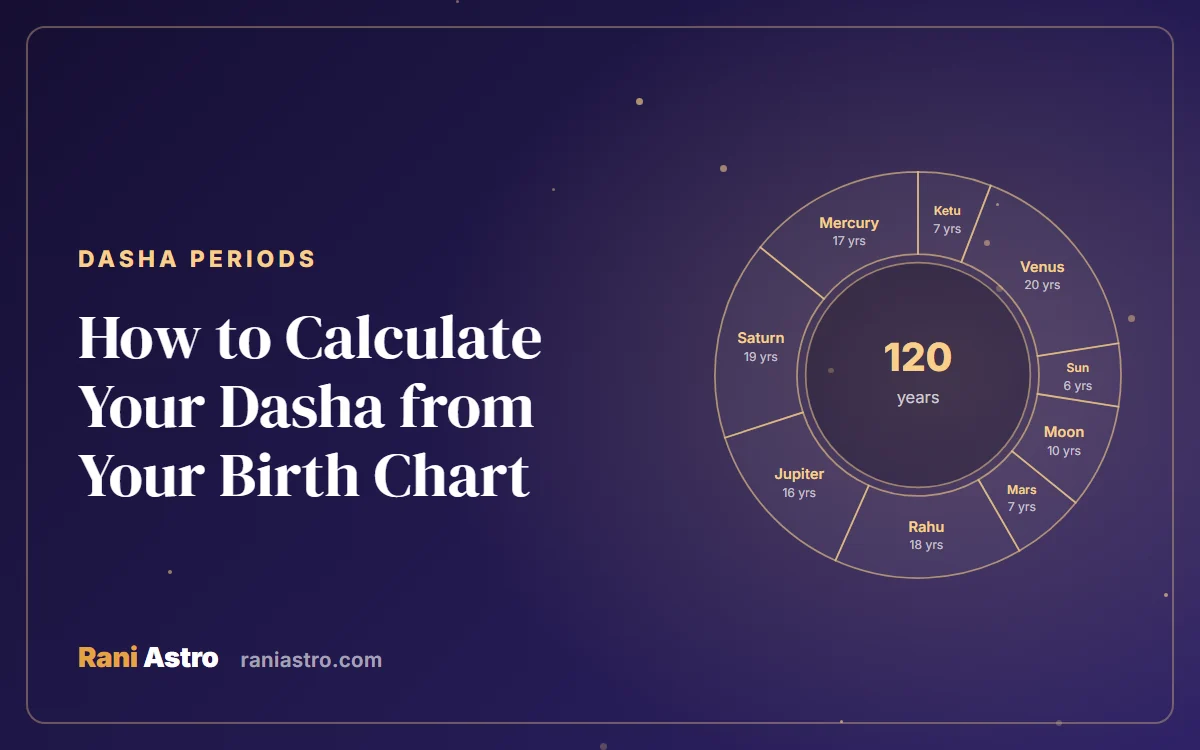
To calculate dasha, you need one number from the birth chart: the Moon's exact sidereal position. Find the nakshatra the Moon sits in, work out what fraction of that nakshatra the Moon had still to cross, and multiply that fraction by the nakshatra lord's years. That is your dasha balance at birth. Every later mahadasha follows in a fixed order.
This page does it by hand, with a full example, so you can check any printout yourself.
Free tool: Dasha Calculator. Your running mahadasha and antardasha, with the full 120-year table.
Why the Moon's Nakshatra Decides the Dasha
Vimshottari dasha is a 120-year cycle of nine planetary periods. Each of the 27 nakshatras has a lord, and the nine lords repeat three times around the zodiac. The Moon's star at birth is treated as your starting point on that wheel. The further the Moon had moved into its star, the less of that lord's dasha you are left with.
Each nakshatra covers 13 degrees 20 minutes, which is 800 minutes of arc. That figure does most of the work in the sums below.
The Table You Need
The zodiac splits into three blocks of 120 degrees: Mesha to Kataka, Simha to Vrischika, Dhanu to Meena. The same nine lords appear in the same degree positions in each block. So one table covers all 27 stars.
| Lord | Years | Degrees inside the block | Stars (block 1, 2, 3) |
|---|---|---|---|
| Ketu | 7 | 0°00' to 13°20' of Mesha, Simha, Dhanu | Ashwini, Magha, Moola |
| Venus | 20 | 13°20' to 26°40' of Mesha, Simha, Dhanu | Bharani, Purva Phalguni, Purva Ashadha |
| Sun | 6 | 26°40' of Mesha/Simha/Dhanu to 10°00' of the next sign | Krittika, Uttara Phalguni, Uttara Ashadha |
| Moon | 10 | 10°00' to 23°20' of Vrishabha, Kanya, Makara | Rohini, Hasta, Shravana |
| Mars | 7 | 23°20' of Vrishabha/Kanya/Makara to 6°40' of the next sign | Mrigashira, Chitra, Dhanishta |
| Rahu | 18 | 6°40' to 20°00' of Mithuna, Tula, Kumbha | Ardra, Swati, Shatabhisha |
| Jupiter | 16 | 20°00' of Mithuna/Tula/Kumbha to 3°20' of the next sign | Punarvasu, Vishakha, Purva Bhadrapada |
| Saturn | 19 | 3°20' to 16°40' of Kataka, Vrischika, Meena | Pushya, Anuradha, Uttara Bhadrapada |
| Mercury | 17 | 16°40' to 30°00' of Kataka, Vrischika, Meena | Ashlesha, Jyeshtha, Revati |
How to Calculate Mahadasha, Step by Step
Here is a made-up birth, worked through completely. A baby is born on 1 January 2000, and the chart shows the Moon at 10°00' in Mesha (Aries), using the Lahiri ayanamsa.
- Find the nakshatra. 10°00' of Mesha falls between 0°00' and 13°20', so the star is Ashwini. Its lord is Ketu, with 7 years.
- Work out how far the Moon has gone into the star. It has crossed 10°00', which is 600 minutes of arc.
- Work out how much is left. The star is 800 minutes long, so 200 minutes remain.
- Turn that into a fraction. 200 out of 800 is one quarter.
- Multiply by the lord's years. One quarter of 7 years is 1.75 years, or 1 year 9 months 0 days. That is the Ketu balance at birth, the dasa iruppu in a Tamil jathagam.
- Add the next mahadashas in order: Venus 20, Sun 6, Moon 10, Mars 7, Rahu 18, Jupiter 16, Saturn 19, Mercury 17.
So the baby's life runs like this.
| Mahadasha | Age | Roughly |
|---|---|---|
| Ketu (balance) | Birth to 1 year 9 months | Until October 2001 |
| Venus | To 21 years 9 months | Until October 2021 |
| Sun | To 27 years 9 months | Until October 2027 |
| Moon | To 37 years 9 months | Until October 2037 |
| Mars | To 44 years 9 months | Until October 2044 |
| Rahu | To 62 years 9 months | Until October 2062 |
On 13 November 2026, this person is running Sun mahadasha.
How to Calculate Antardasha
The antardasha (bhukti) formula is one line. Multiply the mahadasha years by the bhukti planet's years and divide by 120. The first bhukti always belongs to the mahadasha planet, and the rest follow in the same fixed order.
For our example's Sun mahadasha of 6 years:
| Bhukti | Sum | Length | Ends at age |
|---|---|---|---|
| Sun | 6 x 6 / 120 | 3 months 18 days | 22 years 0 months 18 days |
| Moon | 6 x 10 / 120 | 6 months | 22 years 6 months 18 days |
| Mars | 6 x 7 / 120 | 4 months 6 days | 22 years 10 months 24 days |
| Rahu | 6 x 18 / 120 | 10 months 24 days | 23 years 9 months 18 days |
| Jupiter | 6 x 16 / 120 | 9 months 18 days | 24 years 7 months 6 days |
| Saturn | 6 x 19 / 120 | 11 months 12 days | 25 years 6 months 18 days |
| Mercury | 6 x 17 / 120 | 10 months 6 days | 26 years 4 months 24 days |
| Ketu | 6 x 7 / 120 | 4 months 6 days | 26 years 9 months |
| Venus | 6 x 20 / 120 | 1 year | 27 years 9 months |
To change a decimal year into months and days, multiply the decimal part by 12 for months, then multiply what is left by 30 for days. For example, 6 x 18 / 120 is 0.9 years. 0.9 x 12 is 10.8 months, and 0.8 x 30 is 24 days.
Our example person turned 26 years 9 months on 1 October 2026. So on 13 November 2026 they are in Sun mahadasha, Venus bhukti.
The Bhukti Running at Birth
There is one more step people often miss. The baby was not born at the start of Ketu dasha, so the first few Ketu bhuktis had already gone.
- Ketu dasha is 7 years and 1 year 9 months was left, so 5 years 3 months had passed.
- Add up the Ketu bhuktis in order: Ketu 4 months 27 days, Venus 1 year 2 months, Sun 4 months 6 days, Moon 7 months, Mars 4 months 27 days, Rahu 1 year 0 months 18 days, Jupiter 11 months 6 days. Together that is 4 years 10 months 24 days.
- Saturn's bhukti of 1 year 1 month 9 days comes next, ending at 6 years 0 months 3 days. The 5 years 3 months mark falls inside it.
- So the baby was born in Ketu-Saturn, with 9 months 3 days of it left, followed by Ketu-Mercury of 11 months 27 days.
Check: 9 months 3 days plus 11 months 27 days is 1 year 9 months. It matches the balance.
Why Your Answer May Differ from a Printout by a Few Weeks
Most dasha tables count a year as 360 days, the way we did above. Some software uses 365.25 days. That alone moves dates by days or weeks over a long dasha.
The ayanamsa matters more. Lahiri is the default in most Indian software, but an older jathagam drawn with a different ayanamsa can shift every date by months. And the birth time matters most of all, since the Moon moves about half a degree an hour.
Our page on dasha sandhi explains why the weeks around a changeover need extra care when the dates are uncertain.
What About Numerology and Other Dasha Systems?
People also ask how to calculate mahadasha in Vedic numerology. Some numerologists teach their own number-based periods, but the methods differ from teacher to teacher and none of them is the Vimshottari dasha described here. We would not mix the two.
Other astrological dashas exist too. Yogini dasha uses a 36-year cycle and the same nakshatra start. Char dasha in Jaimini astrology runs by signs, not by the Moon's star. Tamil readers will find the bhukti reading explained in our dasa bhukti guide, and the full cycle is in our Vimshottari dasha guide.
If you would rather not do the sums, our Lifetime Horoscope Report prints every dasha and bhukti in your chart with dates, then reads them for your lagna. It costs ₹249 and comes as a PDF on WhatsApp.
Common Questions
How to Calculate Mahadasha and Antardasha Together?
Find the balance of your first mahadasha from the Moon's nakshatra, then add the later mahadashas in order. For each mahadasha, the bhukti length is mahadasha years times bhukti planet years divided by 120.
Can I Calculate Dasha Without the Birth Time?
Only roughly. The Moon moves about 13 degrees a day, so without a time the balance can be off by years, and near a star boundary even the starting planet can be wrong.
What Is Dasa Iruppu?
It is the balance of the first mahadasha at birth, printed in Tamil jathagams in years, months and days. Every later dasha date is counted from it.
Why Does My Jathagam Show a Different Date from an App?
Usually because of a different ayanamsa, a 360-day versus 365.25-day year, or a slightly different birth time.